01
International observatory
LUME MISSION RECORD · 05
The James Webb Space Telescope observes infrared light to study galaxies, stars and planets. Built by NASA, ESA and CSA, it unfolded in space before beginning its observations. Explore how it works and what its images reveal.
THE SAME REGION · DIFFERENT WAVELENGTHS
Some infrared wavelengths pass through dust more easily than visible light. Webb can reveal stars forming inside clouds that hide them from our eyes.

Look at the stars. In Webb’s view of the Pillars of Creation, more stars appear among and around the dusty columns. Both telescopes show the same star-forming region, using different wavelengths.
Look at the colours. Webb’s detectors record infrared light that our eyes cannot see. Colours are assigned to the wavelength ranges to make their differences visible.
NASA · ESA · CSA
Scientists, engineers, technicians and support teams worked across countries and organisations. Their tasks included making the mirrors, assembling the instruments, writing software and testing the observatory for launch and operation in space.

The mirror segments had to work together as one mirror. The instruments were tested in extreme cold, and the assembled telescope underwent vibration and vacuum tests. Engineers also rehearsed the movements needed to unfold it in space.
Construction began in 2004. Webb launched on 25 December 2021, then spent roughly six months cooling down, aligning its mirrors and checking its instruments before its first science results were released.
Meet the international team · NASASources: NASA programme participation · ESA/Webb construction estimates
THREE FIRST RELEASES · THREE WAYS TO READ LIGHT
Explore a deep field, a star-forming region and measurements of an exoplanet’s atmosphere.
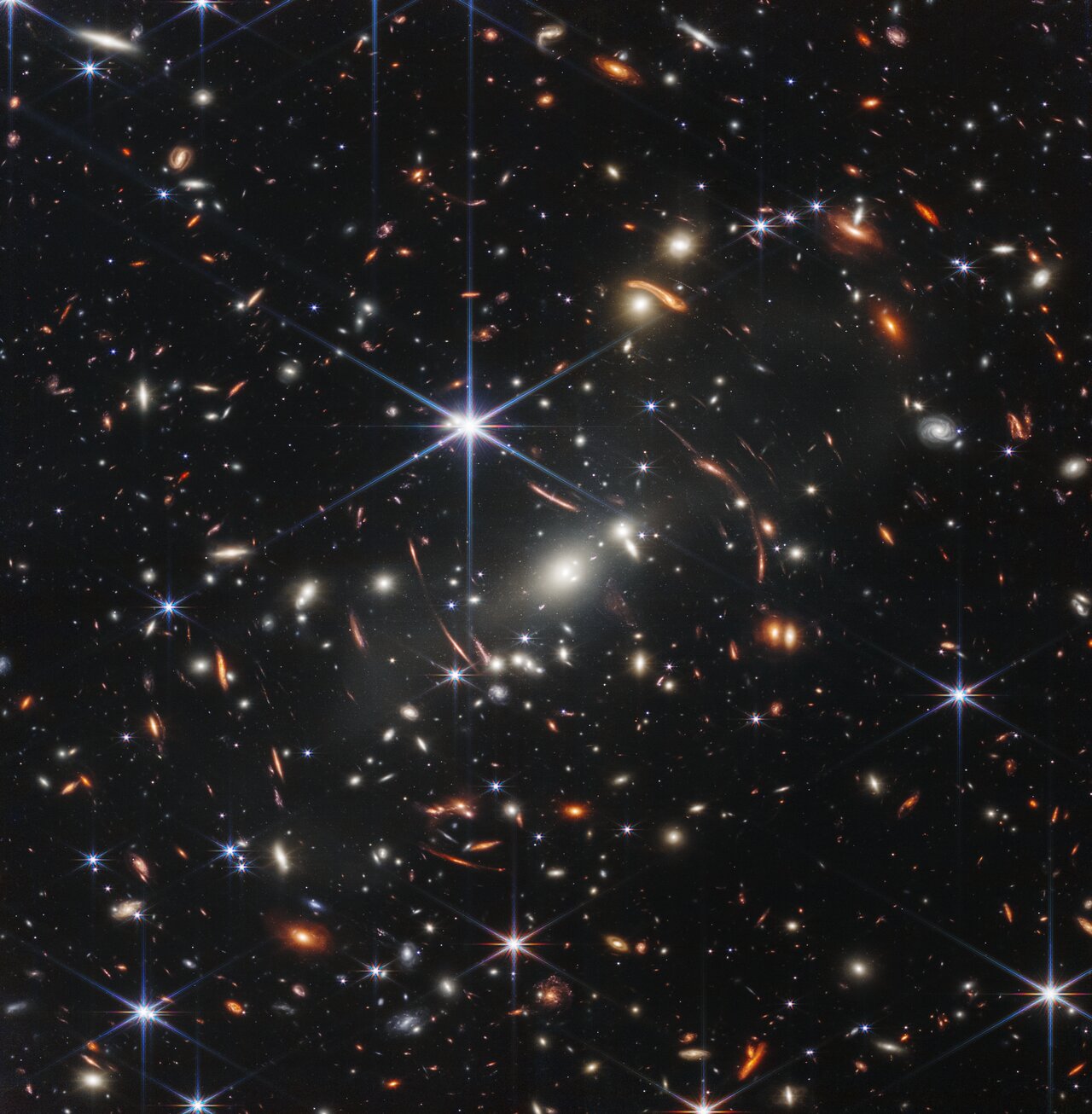 01 · NIRCAMWebb’s First Deep Field
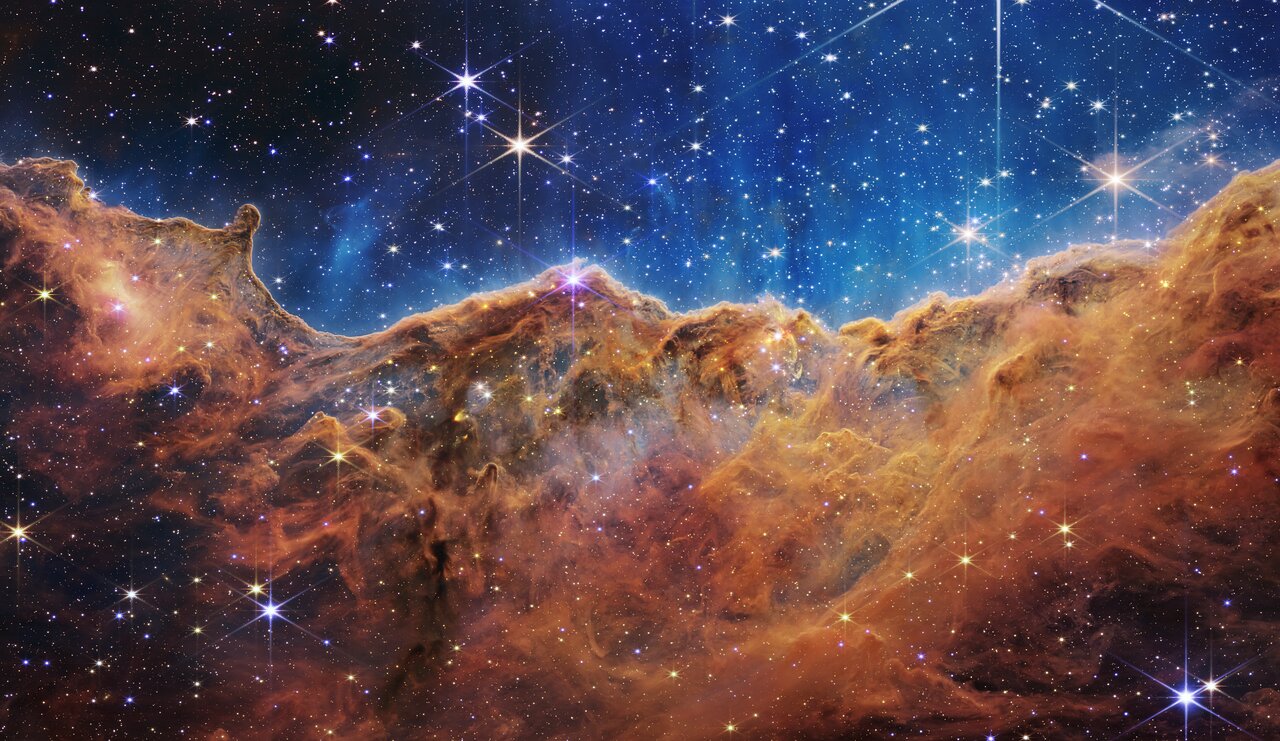 02 · NIRCAMThe Cosmic Cliffs
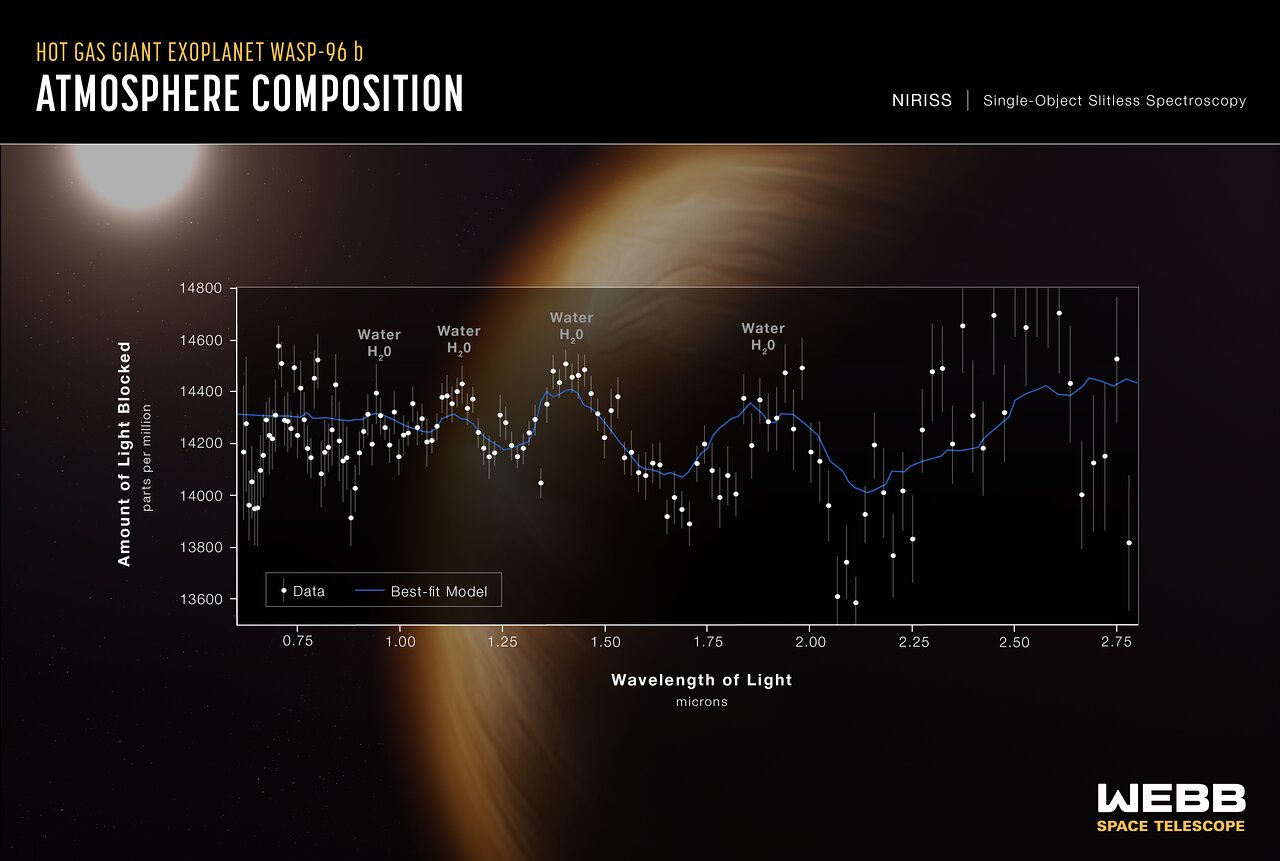 03 · NIRISSWASP-96 b, measured in transit
Official Webb imagery · NASA, ESA, CSA and STScI. Full credits, context and source records accompany each observation below.
ENGINEERING BEFORE IMAGERY
Deployment was not a single event. Each completed operation made the next possible, while the observatory travelled away from Earth.
Copyright: ESA/Arianespace; Camera: Réaltra Space Systems Engineering; Music: “Lonely Waltz” by Charlotte Hatherley, used with permission. Original video and credit ↗
A camera on Ariane 5’s upper stage recorded Webb separating from the rocket, with Earth in the background. Its solar panel begins to open 69 seconds after separation, providing power for the journey ahead.
Animation: NASA’s Goddard Space Flight Center. Original video and credit ↗
Webb’s mirror and sunshield were folded to fit inside Ariane 5. This computer animation shows how the spacecraft opened them after launch, with the sequence compressed into a shorter viewing time.
International observatory
Built to fold
25 Dec 2021 · Launch
The first two weeks · Deployment
24 Jan 2022 · L2
Six months · Commissioning
11–12 Jul 2022 · First science
INFRARED · SPECTROSCOPY · EVIDENCE
Images show where objects and structures are. Spectra show how their light changes across wavelengths, helping astronomers study what they are made of and how they behave.
Detectors measure infrared light through selected wavelength ranges. Colour is assigned so those measurements can be read by human eyes.
Spectrographs separate light by wavelength. The resulting pattern helps astronomers identify gases and study how an object moves.
Astronomers compare the measurements with physical models to estimate properties such as composition and temperature. The conclusions include uncertainties.
FIRST PUBLIC RELEASE · JULY 2022
Three observations from Webb’s first public release, with explanations of what each reveals.
Galaxy cluster SMACS 0723 appears as it was 4.6 billion years ago. Its gravity bends and magnifies light from galaxies behind it. Look for the stretched arcs: they are distorted views of more distant galaxies.
This apparent ridge is the wall of a giant gaseous cavity within NGC 3324. Ultraviolet radiation and stellar winds from massive young stars above the field are eroding the wall, while infrared vision reveals stars and outflows hidden behind dust.
As WASP-96 b crossed its star, some starlight passed through the planet’s atmosphere. Different gases absorb different wavelengths. Webb measured these small changes in the light, detecting water vapour and evidence of clouds and possible haze.
141 wavelength points showing how much starlight was blocked.
Water vapour, with evidence of clouds and possible haze.
The planet and star in the background. Webb did not image them directly.
PRIMARY RECORDS
GET TO KNOW THE MISSION
Webb is a space observatory developed by NASA, ESA and CSA. It studies infrared light from distant galaxies, forming stars, planets and objects in our own Solar System.
Infrared reveals cool objects and can pass through some dust that blocks visible light. It also lets Webb detect light from distant galaxies stretched to longer wavelengths as the universe expands.
It orbits the Sun near the Sun–Earth L2 point, about 1.5 million kilometres from Earth. Its sunshield helps keep the telescope cold enough to detect faint infrared signals.
They are built from measurements through selected filters. Infrared wavelengths are assigned visible colours so we can see structures and compare what the different filters reveal.
Read the official explanations: NASA Webb overview ↗ · ESA/Webb questions ↗ · ESA/Webb image processing ↗