Selected
Fourth mission in NASA’s New Frontiers program.
LUME MISSION OBSERVATORY · 01
NASA’s Dragonfly mission will fly across Titan, Saturn’s largest moon, landing in different places to study its chemistry and landscape. Follow the mission’s progress, from assembly and testing to its planned exploration of Titan.
Explore the missionOriginal LUME Gravity artistic visualisation of a possible flight above Titan’s dunes · Not an agency image or a recorded event
23 Oct · First complete simulated flight succeeds on flight-like avionics.
NASA report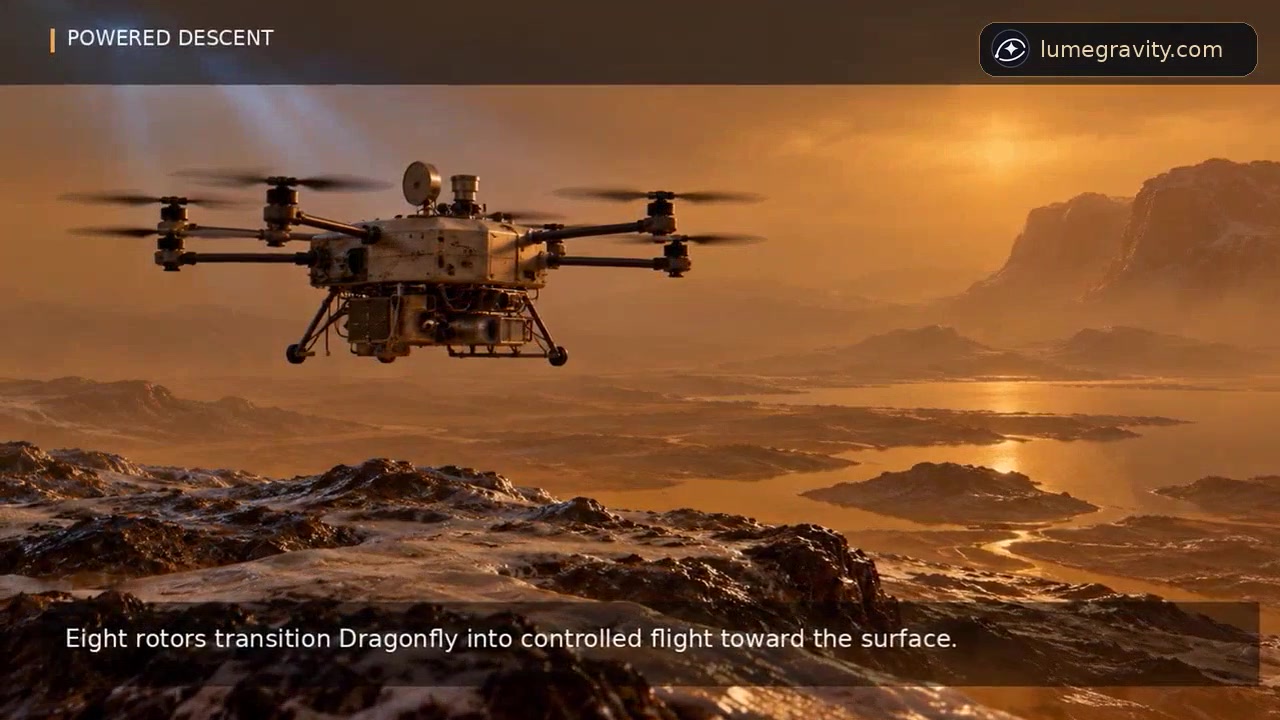 02:42
LUME GRAVITY · ORIGINAL FILM
An original visual journey following Dragonfly from launch to its planned arrival at Saturn’s largest moon.
Watch the film Spanish narration · English on-screen text · Artistic reconstructionNASA · DRAGONFLY · 2019—2026
A selective record of Dragonfly's milestones since NASA chose the mission in 2019. The newest update also appears in the green status above.
First complete real-time simulation of Dragonfly's autonomous first flight and landing succeeds on flight-like avionics.
NASA reportFlight electrical harness installed; Ahmakiq Undae named in Titan's landing region.
NASA reportFuselage delivered after structural tests; systems integration begins.
NASA reportHeat shield material completes thermal and structural tests.
NASA reportRotorcraft integration and testing formally begins at Johns Hopkins APL.
NASA reportNASA reports major progress on rotors, insulation, instruments and flight systems.
NASA reportDragonfly passes its Critical Design Review; construction can advance.
NASA reportNASA formally confirms the mission and its July 2028 launch plan.
NASA reportThe team passes the Preliminary Design Review's technical criteria.
NASA reportNASA selects Dragonfly as the fourth New Frontiers mission, bound for Titan.
NASA reportDates refer to NASA's publication of each report; some events happened earlier. Sources checked 27 Sep 2026 · Curated by LUME Gravity, not a live NASA feed.
THE MISSION IS TAKING SHAPE · NASA / JOHNS HOPKINS APL
Dragonfly’s scientists and engineers show how the rotorcraft is being assembled in the clean room.
MISSION SPINE
No day-by-day countdown yet. We will start one when NASA confirms a launch date. NASA mission status
Fourth mission in NASA’s New Frontiers program.
The team passed the Preliminary Design Review's technical criteria.
NASA formally confirmed the mission.
NASA approved the mission's detailed design and construction plans.
The flight structure is becoming a complete spacecraft.
NASA targets no earlier than July 2028; the launch date is not yet confirmed.
Entry, descent and the first powered flight.
Flights and landings across multiple sites.
Surface operations after arrival: ~115 km from the initial landing site across 20–30 potential sites.
WHY FLIGHT MATTERS
Titan’s dense atmosphere and low gravity allow Dragonfly to travel between geologically different locations. Each landing can be compared with the last, connecting chemistry, geology and weather across a wider landscape.
THE WORLD DRAGONFLY WILL ENTER
Cassini and Huygens revealed clouds, channels, lakes and seas on Titan. At its surface temperature, the liquids participating in that cycle are methane and ethane, not water.
Methane clouds and rainfall are part of an active atmospheric cycle.
Channels feed polar lakes and seas of liquid hydrocarbons.
Vast equatorial dunes hold organic grains shaped by wind.
SCIENCE ON BOARD
Dragonfly will examine chemistry, elemental composition, landforms, weather, geophysics and samples collected from Titan’s surface.
Mass spectrometry for chemical components and biologically relevant compounds.
Gamma-ray and neutron measurements of surface elements.
Surface and aerial views across multiple scales.
Drills and transfers surface material to DraMS.
Meteorology, regolith properties and seismic activity.
QUESTIONS WE WILL FOLLOW
What conditions can Titan provide for complex chemistry?
How far have chemical pathways associated with life’s origins progressed?
How do atmosphere, dunes, impact deposits and subsurface materials interact?
What can repeated measurements reveal about Titan’s weather and active processes?
GET TO KNOW THE MISSION
Dragonfly is a robotic rotorcraft designed to explore Titan, Saturn’s largest moon. It will fly between landing sites and use its instruments to study the surface and atmosphere.
Titan has a thick atmosphere, dunes and lakes of liquid methane and ethane. Its rich organic chemistry offers a place to investigate the chemical processes associated with the origins of life.
Titan’s dense atmosphere and low gravity make flight easier than on Earth. Dragonfly will use eight rotors to travel between sites, exploring terrain that could be difficult for a wheeled rover to cross.
It will analyse surface samples, examine landforms and measure weather and other environmental conditions. Comparing different sites will help scientists understand Titan’s chemistry and whether it offers conditions suitable for life.
Explore NASA’s explanations of Dragonfly’s science and how it will fly on Titan.
A LIVING RECORD
Follow the mission through construction, launch, its journey to Titan and surface exploration.
Verified engineering milestones and clear explanations of the spacecraft.
Confirmed dates, mission events and links to official broadcasts.
Trajectory milestones and the science of reaching Saturn’s system.
Landing sites, measurements and results, separated from interpretation.
Official records
NASA Dragonfly missionNASA spacecraft & instrumentsNASA Dragonfly news