Voyager 1
- Earth · 1977
- Jupiter · 1979
- Saturn & Titan · 1980
- Interstellar space · 2012
LUME MISSION OBSERVATORY · 03
NASA’s Voyager 1 and 2 launched in 1977 to explore the giant planets. They now study interstellar space, beyond the bubble of particles flowing from the Sun. Follow what they saw and how their journeys continue.
Original LUME Gravity composition · Mission data: NASA Science and JPLONE DESIGN · TWO TRAJECTORIES
Voyager 1 took the faster path past Jupiter and Saturn. Voyager 2 continued through the only close reconnaissance ever made of Uranus and Neptune. Their routes now leave the Sun in different directions.
Chronology and divergence shown schematically; distances are not to scale.
1979—1990 · THROUGH THEIR CAMERAS
The photographs below were made by the Voyager spacecraft. Follow the journey in the order the worlds came into view; each image opens its NASA record.
 Voyager 1 · NASA/JPL · colour composite
01 / 1979 · VOYAGER 1 + 2
Voyager 1's colour-filter images revealed the intricate clouds around the Great Red Spot. The encounters also exposed active volcanoes on Io and a faint ring around Jupiter.
 Voyager 1 · NASA/JPL/USGS · colour composite
02 / 1980—81 · VOYAGER 1 + 2
The two flybys exposed fine ring structure and a family of icy moons. Voyager 1 turned toward Titan's dense orange haze; Voyager 2 kept the route to Uranus and Neptune open.
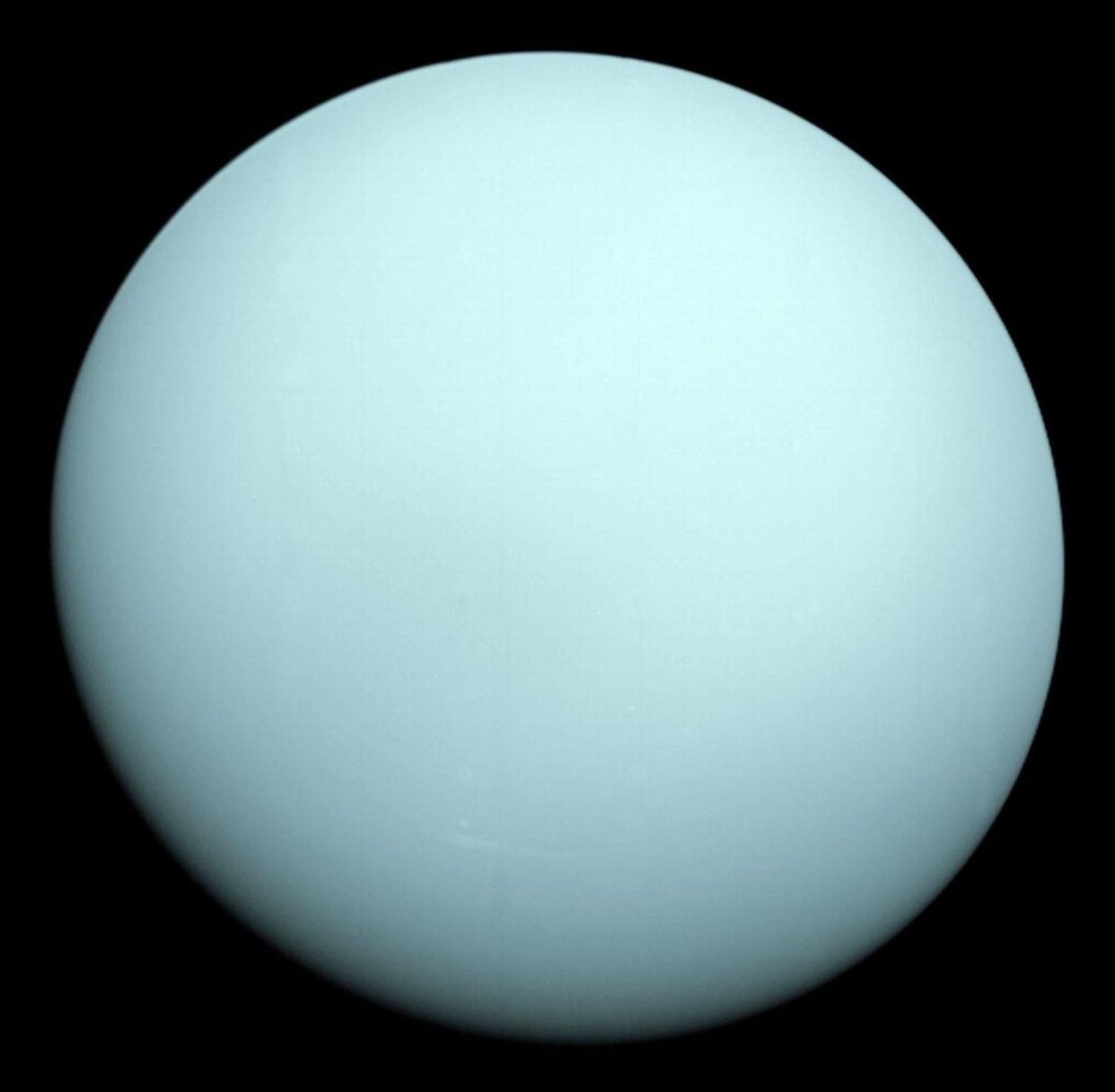 Voyager 2 · NASA/JPL-Caltech
03 / 1986 · VOYAGER 2
The only close encounter with Uranus revealed a pale atmosphere, dark rings and moons. Its almost featureless disc in visible light was itself a startling change after Jupiter and Saturn.
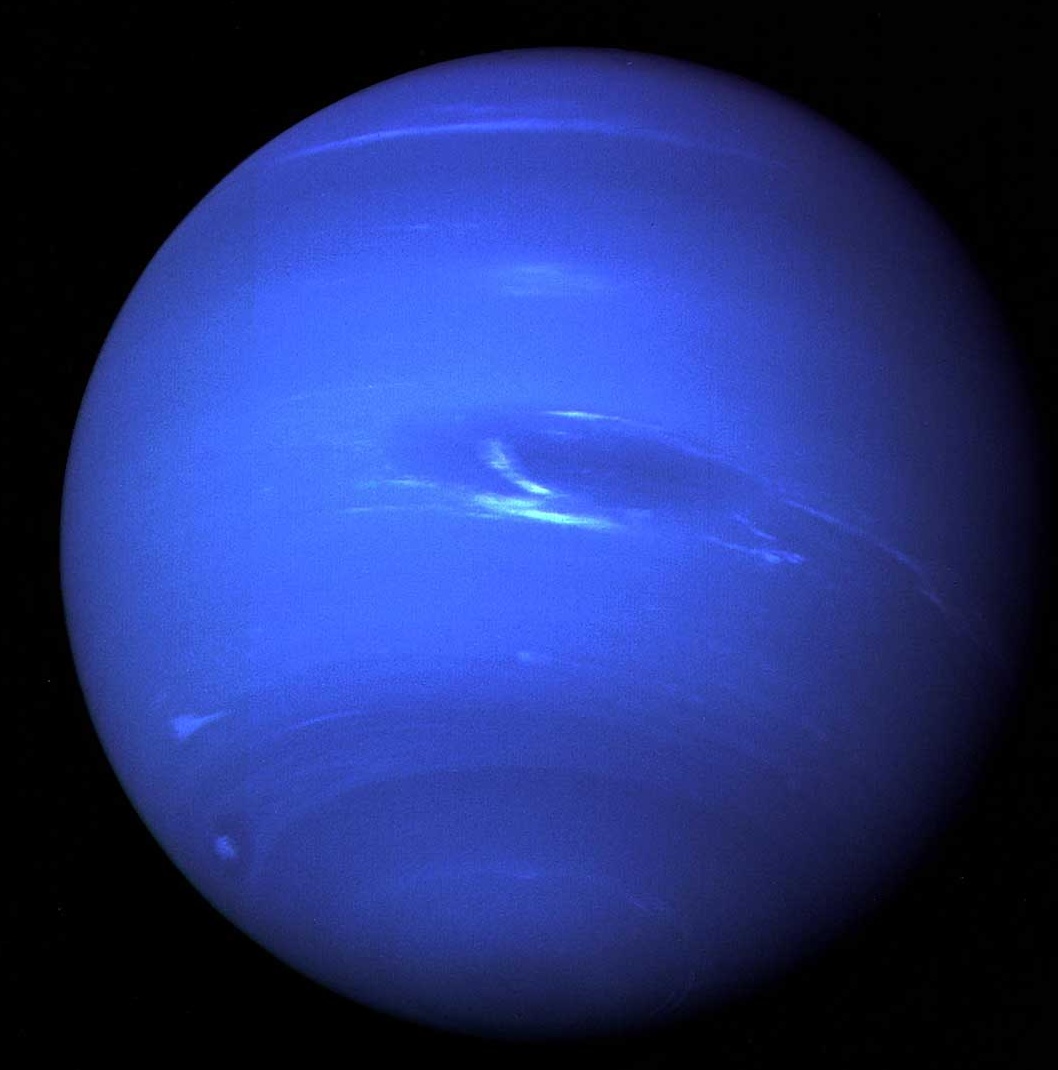 Voyager 2 · NASA/JPL
04 / 1989 · VOYAGER 2
Voyager 2's final planetary encounter revealed dark storms, fast winds and Triton, where it observed active plumes.
 Pale Blue Dot · Voyager 1 · NASA/JPL-Caltech
14 FEB 1990 · VOYAGER 1
Beyond Neptune, Voyager 1 made a final family portrait of the solar system. Earth is a faint point in a scattered ray of sunlight. The cameras were switched off after this sequence; the journey continued without pictures.
Explore the original imageTHE INTERSTELLAR MISSION
The cameras no longer observe planets. Surviving instruments measure particles, fields and plasma beyond the heliopause. As their radioisotope generators lose power, engineers progressively switch off systems to preserve the remaining science.
ENGINEERING ACROSS DECADES
Voyager’s longevity is also the record of mission teams who inherited an ageing spacecraft, studied decisions made decades earlier and found careful solutions under extraordinary constraints.
After the antenna shifted two degrees away from Earth, the Deep Space Network sent an interstellar ‘shout’. Full communication returned after a 37-hour round trip.
NASA mission recordEngineers divided affected flight-software code and relocated it across the remaining memory. Readable engineering and science data returned.
NASA mission recordA team re-examined a failure accepted in 2004 and restored roll thrusters once considered unusable, creating a vital backup.
NASA mission recordA coordinated ‘Big Bang’ reconfiguration avoided another instrument shutdown in 2026 and should keep Voyager 2’s three remaining science instruments operating for at least an extra year.
NASA mission recordThese are selected, documented examples—not a complete account of the people or work sustaining Voyager.
THE GOLDEN RECORD
Each Voyager carries a phonograph record selected as an account of its planet of origin.
The records also contain natural sounds and printed messages. NASA describes their possible discovery as dependent on an advanced spacefaring civilisation encountering either spacecraft.
GET TO KNOW THE MISSION
Two NASA robotic spacecraft launched in 1977. Both explored Jupiter and Saturn; Voyager 2 continued to Uranus and Neptune before their journeys extended into interstellar space.
The region beyond the heliosphere, the bubble formed by the solar wind. Voyager 1 crossed its boundary in 2012 and Voyager 2 in 2018.
Not in the broad gravitational sense. They are beyond the solar-wind bubble, but have not yet reached the distant Oort Cloud, a region of icy bodies still associated with the Sun.
Their remaining instruments study the environment beyond the heliosphere, including particles, magnetic fields and plasma waves. Declining electrical power limits what the spacecraft can operate.
Read the official explanations: NASA interstellar mission ↗ · NASA Voyager questions ↗
OFFICIAL SOURCES
NASA Science · Voyager missionNASA Science · Voyager 1NASA Science · Voyager 2NASA · Mission updatesNASA Science · Golden Record