Image released on 23 November 2026
Mira A
A loop of gas above a red giant
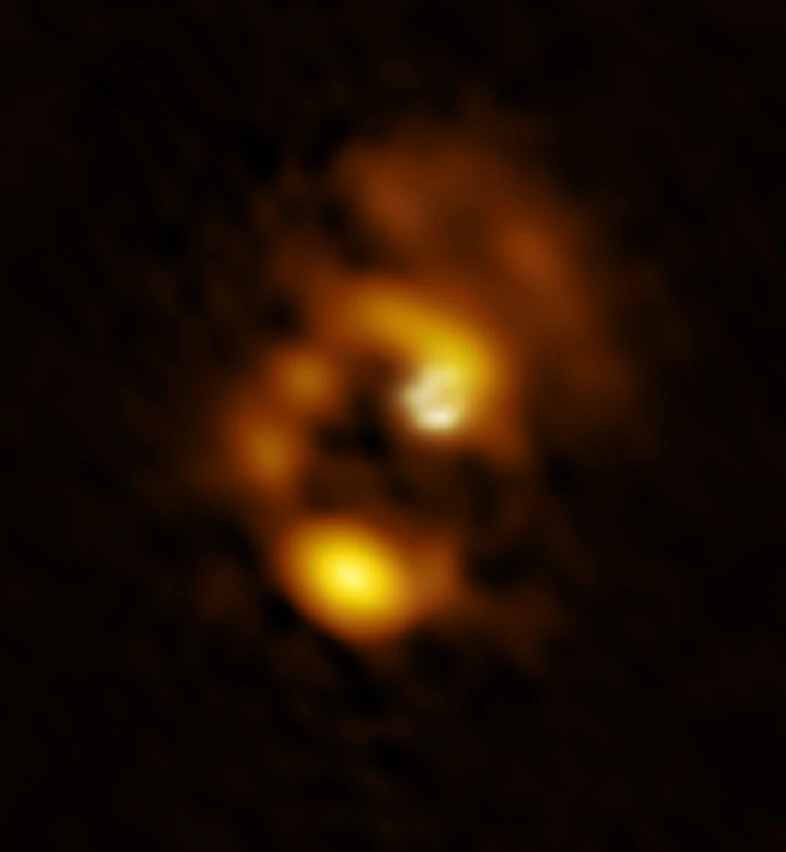
About 330 light-years away in Cetus, Mira A is shedding its outer layers. ALMA has resolved the shape of one of its eruptions. A loop of gas rises above the star’s surface to roughly the distance between the Sun and Saturn.
A clue from two years earlier
When the team traced the gas back, an earlier observation offered a clue. Two years before, a hot spot had appeared on the stellar surface where the loop seems to have originated. The polarisation of the light also revealed a magnetic field. The team is investigating how much material Mira A sheds through eruptions like this one.
How ALMA saw it from Chile
ALMA’s antennas in the Atacama Desert work together as one radio telescope. For this image they collected waves 1.394 millimetres long emitted by the gas. The golden tones represent that signal, which is invisible to the human eye.