Beyond our own Milky Way, whole worlds of stars take shape, meet, and change. Five real observations. Five ways to see a galaxy differently.Enter the first galaxy ↓
These are telescope observations assembled and processed from measured light, not imaginary views. The colours and framing help reveal physical structures; the original record stays one tap away.The movement as you scroll adds depth; it does not show the galaxies moving in real time.
01 / SPIRAL · M51
The Whirlpool
A spiral with a companion.
Its sweeping arms are lanes of stars, gas and dust. The smaller galaxy NGC 5195 passes behind it; their gravitational encounter helps drive waves through the disk and compresses gas into new stars.
Hubble's visible-light mosaic reveals the extended glow of the central bulge. Switch to Webb's mid-infrared view and the smooth inner disk and clumpy dust ring emerge differently. These are two ways of observing the same galaxy, not a time sequence.
These once-separate spirals are merging. Pink gas and bright blue clusters mark vigorous star formation. The long tidal tails that give the pair its name extend beyond this close Hubble view.
A high-speed encounter sent expanding rings through a former spiral. Switch between Hubble's optical and near-infrared view and Webb's near- and mid-infrared composite. The contrast comes from different wavelengths and processing, not a time sequence; their colours are not what unaided eyes would see.
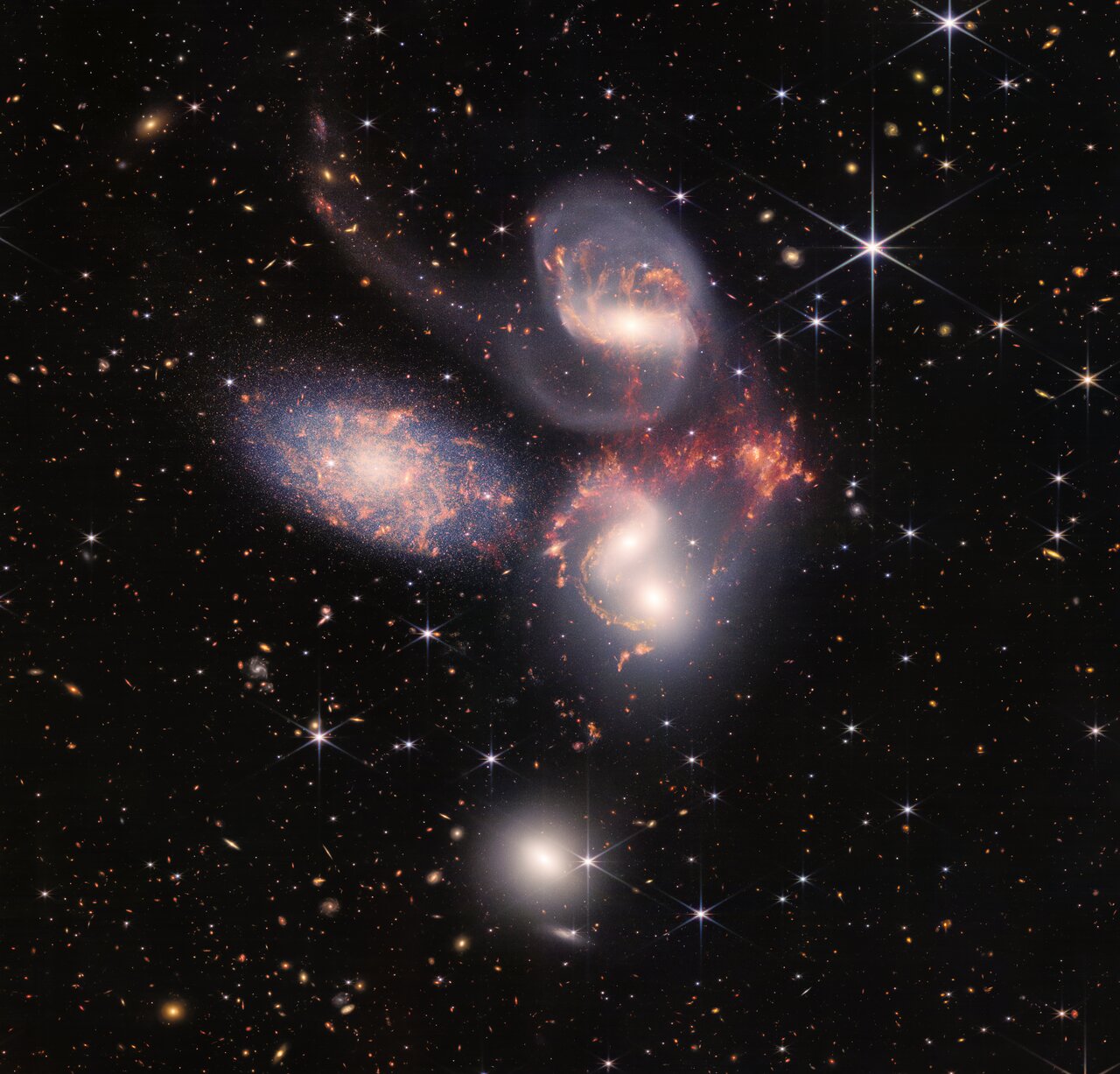
The leftmost galaxy is much nearer to us than the other four. Among the interacting members, Webb reveals star-forming regions, stripped material and a shock wave as one galaxy moves through the group.
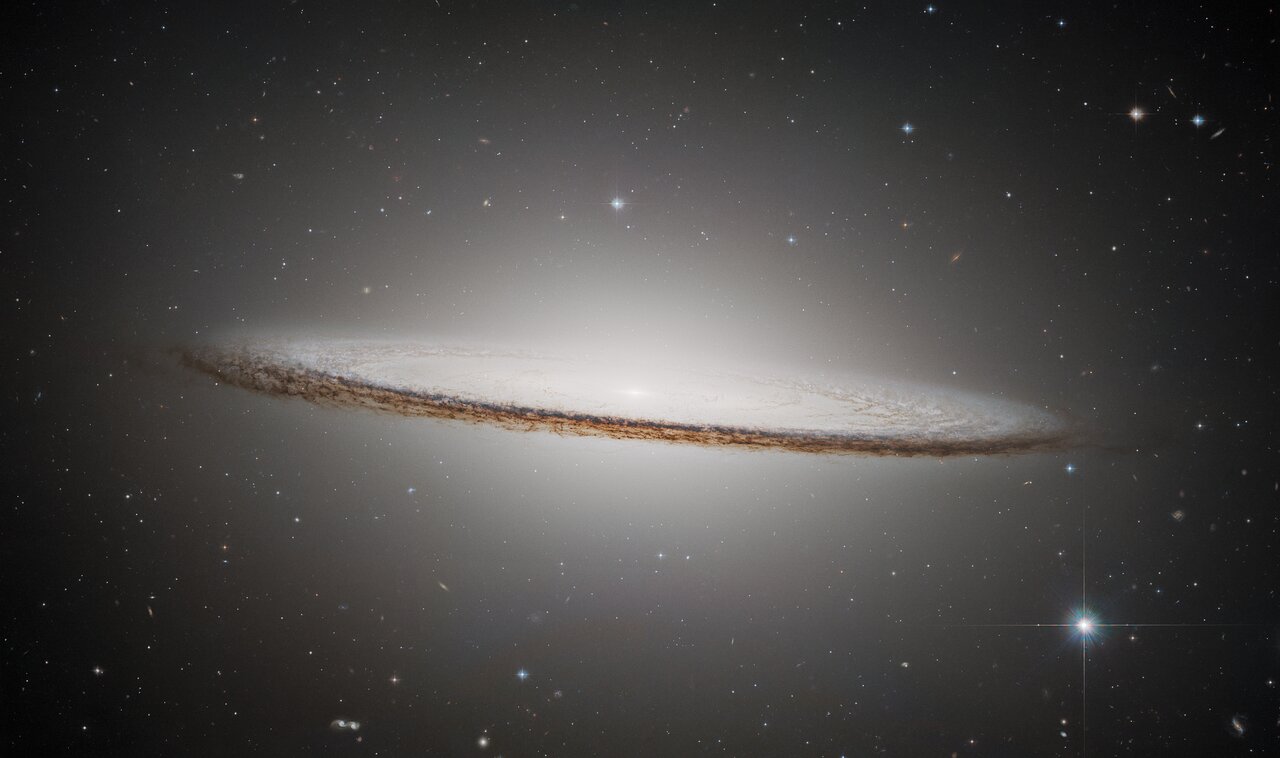
Images: ESA/Hubble and ESA/Webb, each linked to its original record with the complete image credit. Different instruments and wavelengths are not presented as natural-eye colour. Image sizes and distances are not to scale.