Repeated observations track its position on the sky.
ESA · Gaia measurementsOUR GALAXY
The Milky Way.A map in motion.
We live inside the system we are trying to chart. Measurements of stars’ positions, distances, motion and light help us reconstruct its structure.
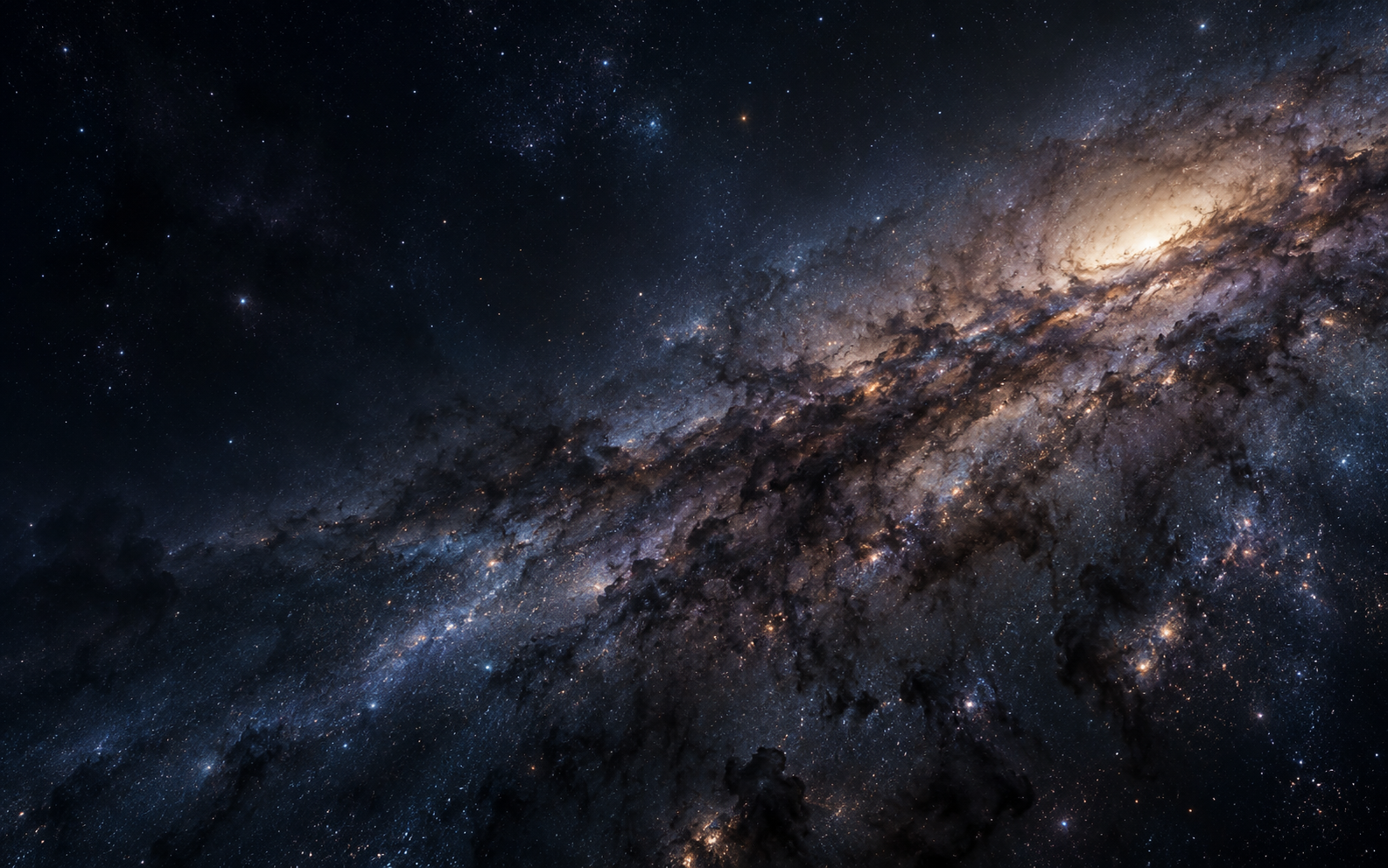
ESA / GAIA
The sky becomes a map.
Gaia measured where stars appear and how their positions change. Distances and motion turn points of light into a three-dimensional picture of our galactic neighbourhood.
Explore the Gaia mission · ESA- Science observations
- 2014–2025
- Stars and other objects surveyed
- ~2 billion
Gaia’s observing phase ended on 15 January 2025. Work continues on its data releases and the scientific analysis of its measurements.
End of observations · ESAAnnual parallax provides a geometric measure of distance for many stars.
ESA · parallaxProper motion traces movement across the sky; shifts in spectral lines reveal motion along our line of sight.
ESA · stellar motionA JOURNEY THROUGH THE DATA / ESA · 2016
From the Sun to the Hyades.
The film follows a route from the Solar System to the Hyades cluster, around 150 light-years away, then places these nearby stars within the wider Milky Way.
Its stellar positions come from the Tycho–Gaia Astrometric Solution, combining early Gaia measurements with the Hipparcos and Tycho-2 catalogues. The journey is a computer visualisation built from measured stellar positions.
Film and context · ESAFROM OUR PLACE IN THE DISK
We do not photograph the Milky Way from outside. We reconstruct it from within.
That reconstruction changes as observations improve. Gaia has revised our picture of the spiral arms and central bar; the Galaxy’s mass distribution is inferred from the motion of objects within and around it.
ESA · evolving mapOPEN QUESTION