
EXOPLANETS / A giant losing its atmosphere
WASP-12 b
Too close to its star.
A WORLD APART
Too close to its star.
On Earth, a day barely begins before another is on its way. In that same span, WASP-12 b almost completes an entire year. This giant circles its star in about 1.1 Earth days, close enough for fierce heating and powerful gravitational tides to reshape it.
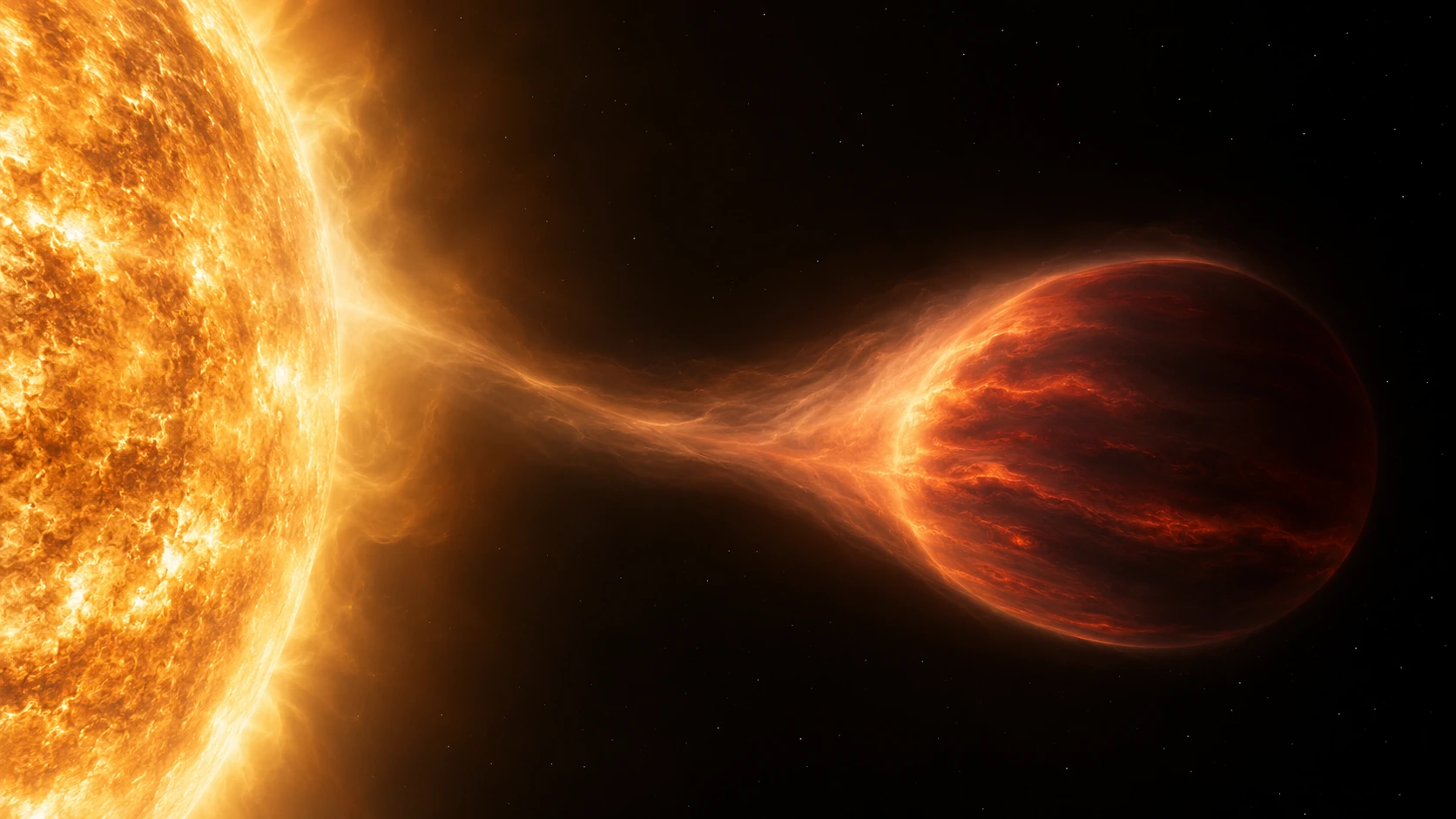
Hubble observations reveal a greatly extended atmosphere, with material escaping towards the star. Our illustration gives that process a visible form, but no telescope has photographed such a detailed stream. The planet’s day side reaches around 2,600 °C. It also reflects remarkably little visible light; its hot atmosphere absorbs much of the light falling on it, while its own heat makes it glow.
- one complete year
- ≈26 hours
- on its intensely heated day side
- ≈2,600 °C
- an atmosphere spilling towards the star
- Escaping gas
A CLOSER LOOK
A whole year, in about a day.
A year is one trip around a star. WASP-12 b needs about 1.1 Earth days; Earth needs about 365. The bars compare time, not orbital distances.
How we know
Hubble’s ultraviolet measurements revealed an extended, escaping atmosphere. The shape and gas stream in our LUME artwork illustrate the interpretation of those data; they are not a resolved photograph.
Sources & image credits
Original LUME GRAVITY visualisation. The illustration is an interpretation, not telescope imagery. The comparison graphic is a LUME Gravity schematic.