The crater on Dimorphos

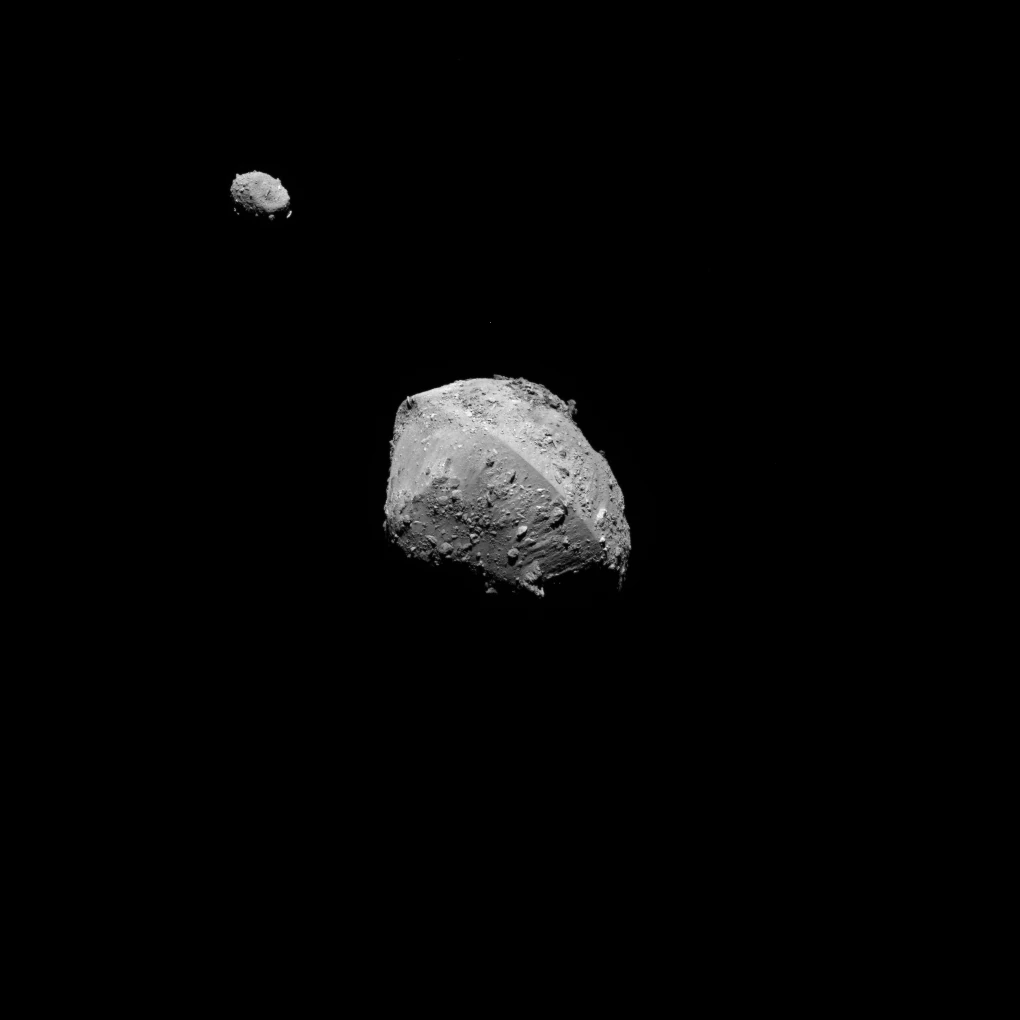
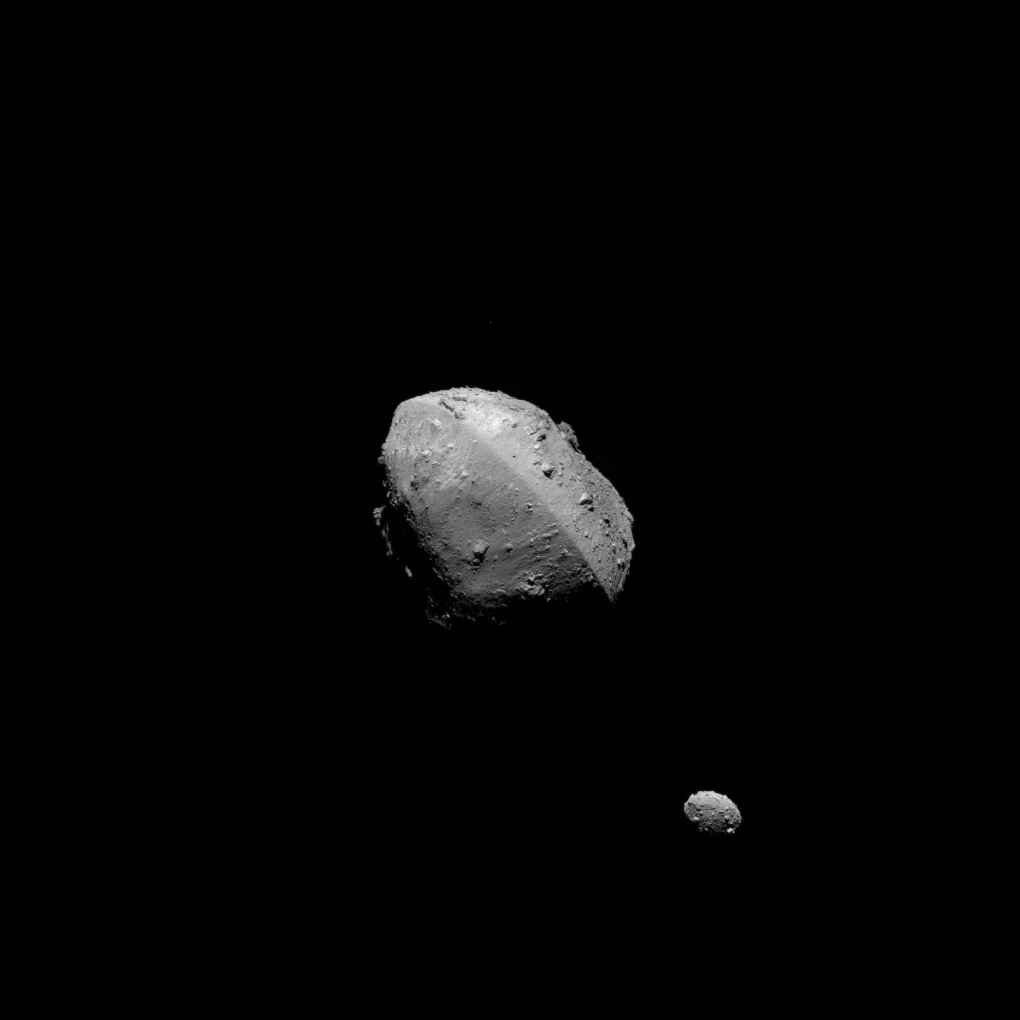
In 2022, NASA’s DART spacecraft struck Dimorphos, the small moon of asteroid Didymos. Four years later, Hera has photographed the scar. The crater is as wide as the face that took the impact.

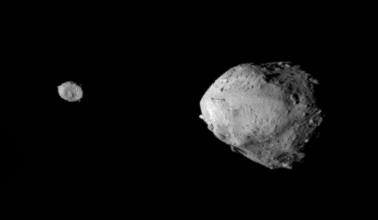
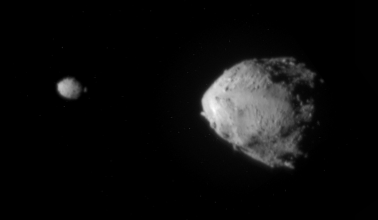
Hera shows the flattened profile of the face of Dimorphos struck by DART.Before impact, Dimorphos has a rounded profile to the left of Didymos.
Move the slider and watch the smaller body on the left. The two cameras saw it from similar angles.Original comparison · NASA/Johns Hopkins APL · © ESA/AFC

What Hera saw

Hera’s cameras reveal the tumble of Dimorphos, pick out boulders moving around the two asteroids and show the surface even in shadow.

A STORY IN THREE MOMENTS

First, the impact.
Then, a closer look.

To understand Hera's mission, we must return to the night a NASA spacecraft deliberately struck an asteroid.

2022 · NASA / DART

The impact.

DART struck Dimorphos, the small moon of asteroid Didymos. Its orbit around Didymos became about 33 minutes shorter: the first measurable change humans made to a celestial body's motion.

Official illustration: DART before impact · NASA/Johns Hopkins APL/Steve Gribben. This is an artist’s rendering, not a photograph.
2026 · ESA / HERA

The return.

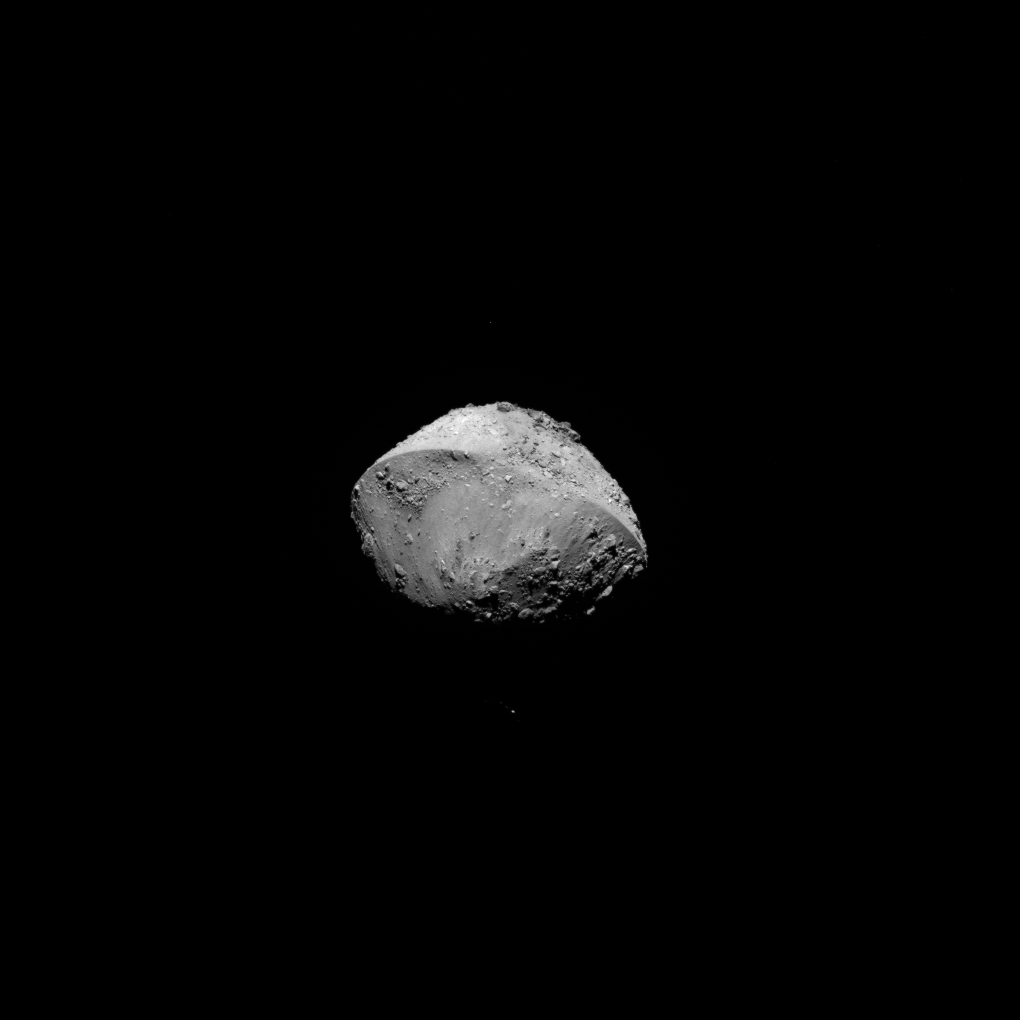
Hera has reached the asteroid pair to find out what really changed. This photograph shows the larger body, Didymos; DART's target was its smaller companion, Dimorphos.

Real photograph: Didymos seen by Hera on 6 November 2026 · ©ESA.
25 NOVEMBER 2026 · ESA

The crater.

The impact flattened one face of Dimorphos. As the little moon tumbles, the crater swings in and out of Hera’s view.

Image taken on 7 November 2026 from 29 km away. © ESA / AFC.
DART’s camera kept transmitting through the final moments of its approach.Watch DART’s final approach
2022DART impact
~33 minutesShorter orbital period
151 mApproximate diameter of Dimorphos
REAL FOOTAGE · NASA

DART’s final moments.

Its camera sent images all the way to the impact. The approach sequence below is sped up for viewing, except for the last frames.

A small strike against an enormous world.

DART · impact mass580 kgNASA spacecraft · calculated impact mass 579.4 kg
Dimorphos · estimated mass5 million tonnesRoughly 8.6 million times DART’s mass

DART carried a camera, DRACO, to identify its target and guide itself to it. Tiny in comparison, it arrived at about 6.1 km/s and shortened Dimorphos’s orbit around Didymos by roughly 33 minutes.

Dimorphos’s mass is still an estimate with substantial uncertainty. Hera will measure it more precisely; this is not the mass of Didymos.

DART’s final minutes. Real images from its DRACO camera; the signal ended on impact. Video: NASA/Johns Hopkins APL. Original source.
REAL OBSERVATION · 6 NOVEMBER 2026

We can see the scene now.

Didymos is no longer a point of light. From 28.5 km away, Hera’s camera reveals an equatorial ridge, large boulders and smoother regions. Its smaller companion, Dimorphos, was struck by DART.

Real monochrome image of Didymos taken by Hera’s camera, with a prominent equatorial ridge
Didymos seen by Hera. Image acquired on 6 November from about 28.5 km; approximately 2.7 m per pixel. Image: ©ESA.
TWO ASTEROIDS · ONE QUESTION

Where is Dimorphos?

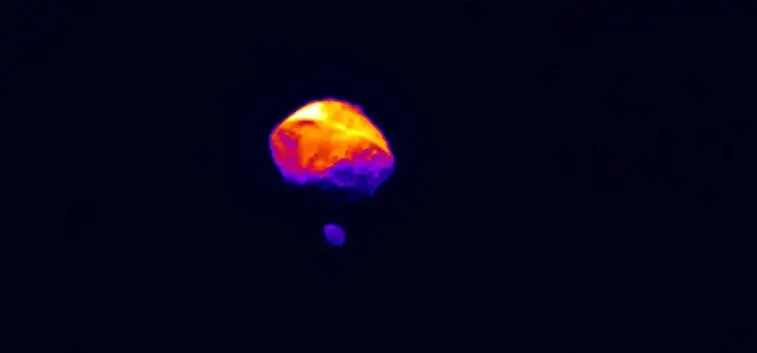
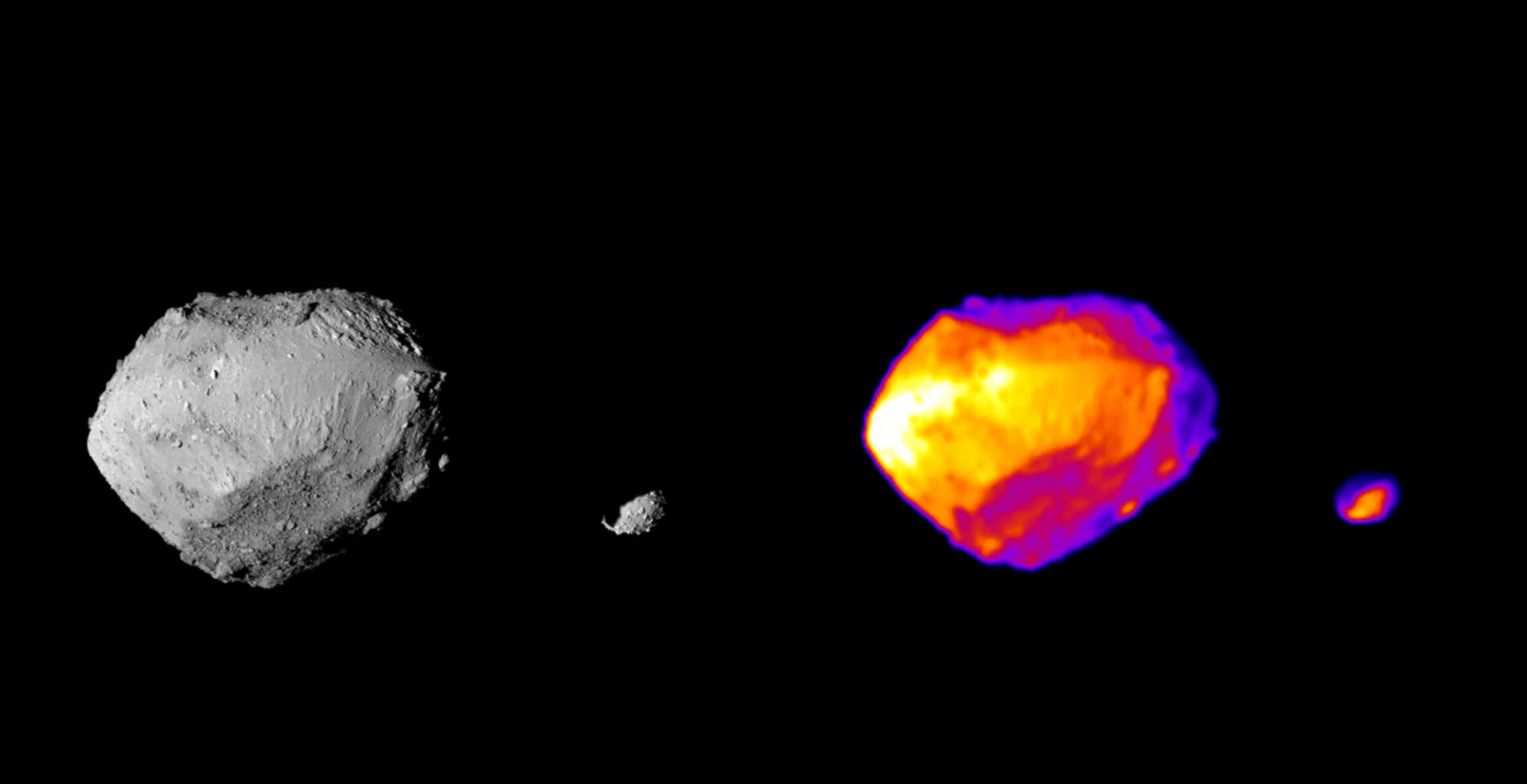
In the first visible-light images it is almost hidden in shadow. Yet the JAXA-supplied thermal imager TIRI can reveal its entire body through the infrared radiation it emits.

Thermal infrared image of Didymos and Dimorphos, showing Dimorphos even in shadow
Hera’s thermal view. Colours represent temperatures, not the asteroids’ appearance to the eye. Image: ©ESA/JAXA.
A DIFFERENT WAY TO SEE

One rock. More than one perspective.

Shape tells part of the story. Reflected light and heat help investigate the surface materials.

Monochrome visible-light view of Didymos

Asteroid Framing Camera

The terrain, boulders and equatorial ridge emerge in detail.

Real photograph · ©ESA
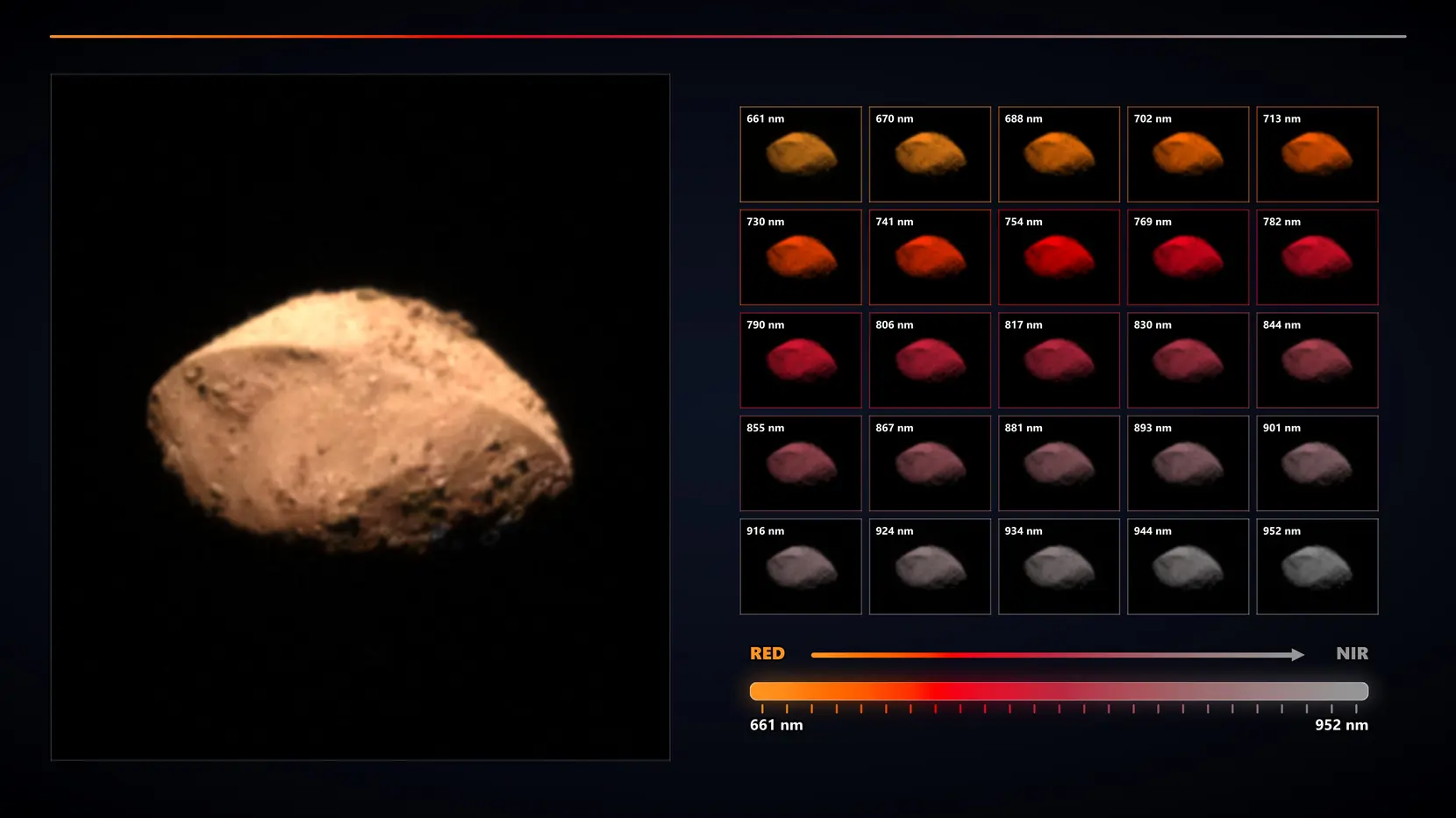
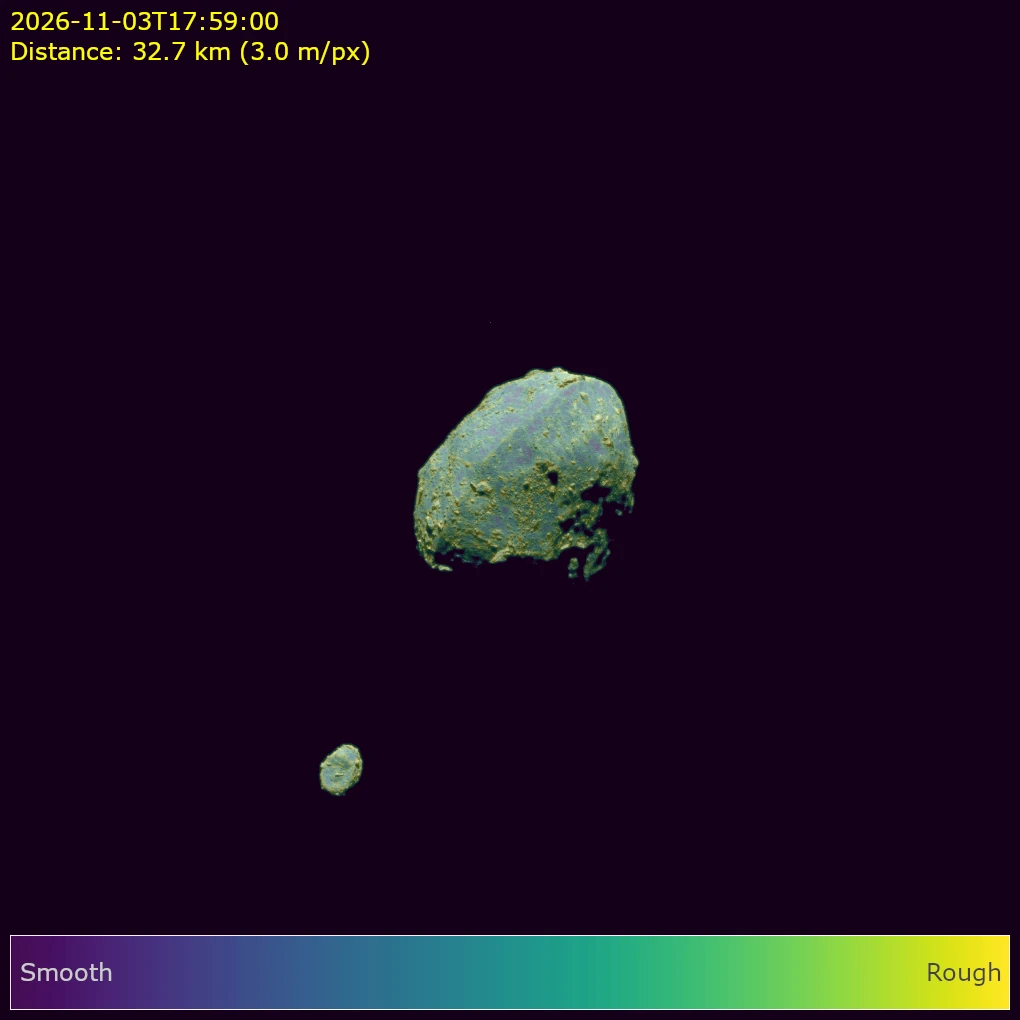
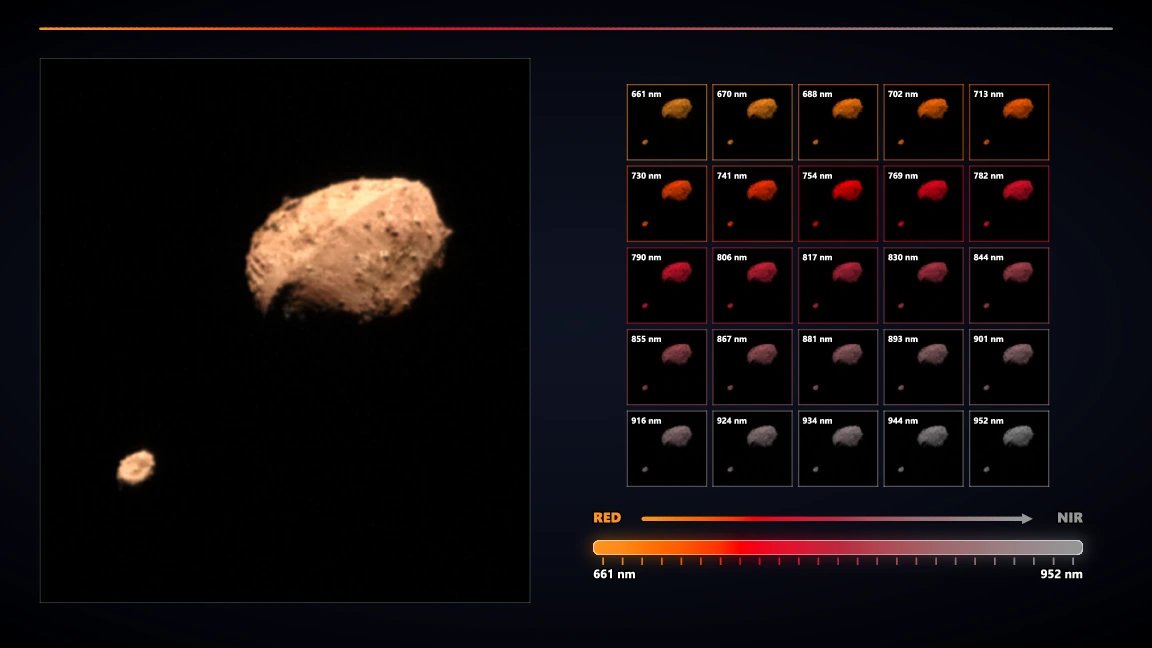
Multispectral image of Didymos with analysis colours

HyperScout H

It combines information in 25 bands to study how the surface reflects light.

Multispectral image · ©ESA
THE EXPERIMENT

We moved an asteroid. Now we need to understand it.

What do we know?

DART struck Dimorphos in September 2022 and shortened its orbit around Didymos by about 33 minutes.

What remains unknown?

Hera will keep measuring the mass of Dimorphos and investigating its interior. Both will help explain why the impact shifted its orbit so much.

Why does it matter?

Those measurements will help assess the kinetic impact technique for future potentially hazardous asteroids.