Launch
MPO and Mio set out together from Europe’s Spaceport in Kourou.
MERCURY · ESA / JAXA · MISSION OBSERVATORY
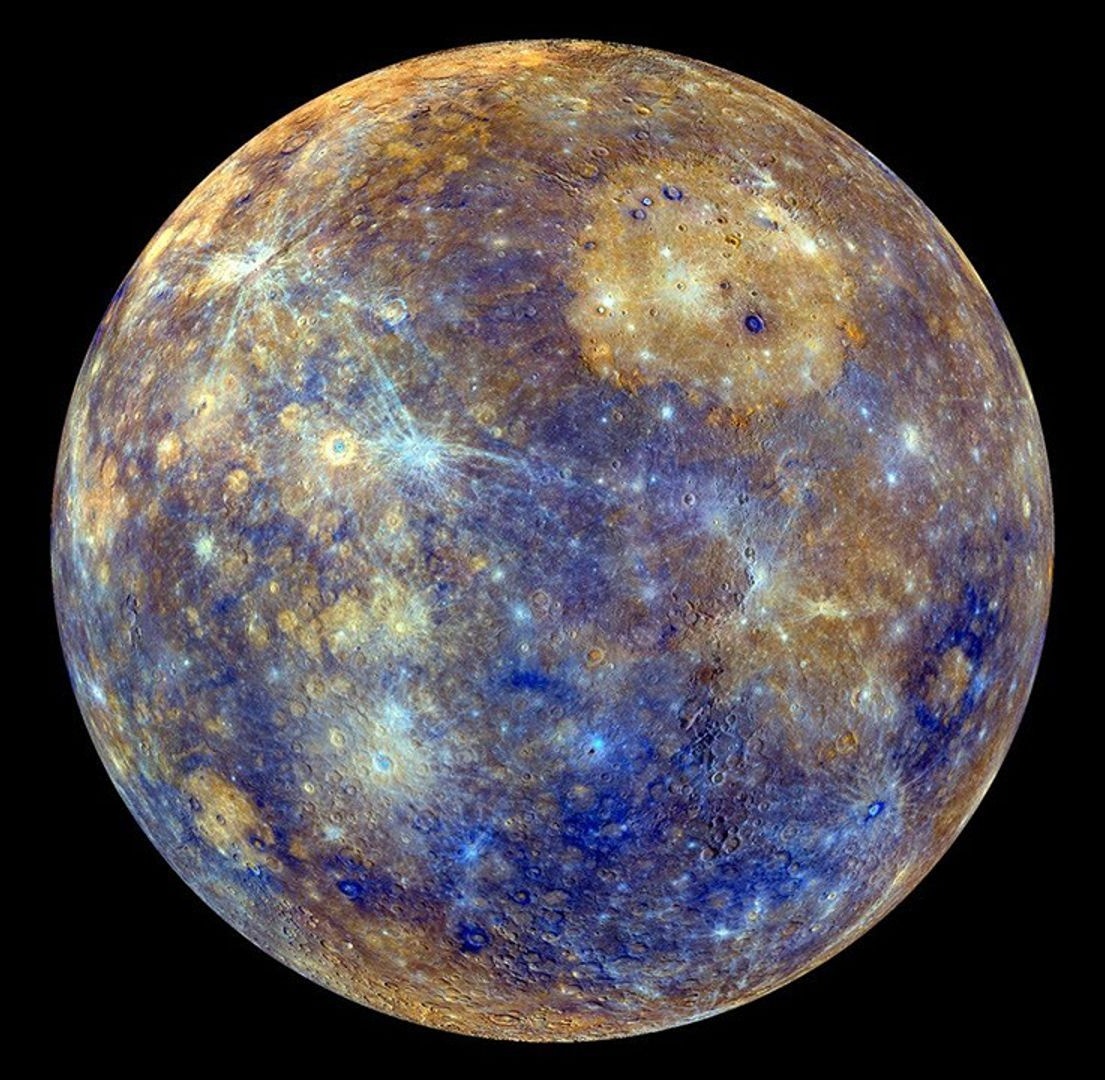
Two orbiters are approaching the Solar System’s innermost planet.
01 / ARRIVAL, NOT LANDING
After eight years travelling through the inner Solar System, BepiColombo has begun its arrival sequence. The combined ESA–JAXA spacecraft is scheduled to enter orbit on 21 November 2026. Its two science orbiters, MPO and Mio, are scheduled to separate in December.
BepiColombo will not land on Mercury. The spacecraft will study the planet from orbit. Routine science operations are scheduled to begin in April 2027.
EARLY INSTRUMENT CHECKS · ESA UPDATE, 06 OCT 2026
After the transfer module separated, ESA switched on MPO’s science instruments together for the first time. BELA fired its laser during a health check, MERTIS tested its instrument performance while looking into deep space, and SIMBIO-SYS took its first image in space. These are commissioning tests, not observations of Mercury from orbit.
02 / THE ARRIVAL SEQUENCE
Dates for future events follow the current ESA mission schedule and may change.
MPO and Mio set out together from Europe’s Spaceport in Kourou.
A sequence of planetary assists guided the spacecraft towards Mercury orbit.
The Mercury Transfer Module separates. MPO continues the final approach with Mio still attached.
The combined MPO–Mio spacecraft is scheduled to enter orbit around Mercury.
The two orbiters are scheduled to move into their separate science orbits.
Routine science observations are scheduled to begin.
03 / TWO SCIENCE ORBITERS
EUROPEAN SPACE AGENCY
Mercury Planetary Orbiter
Eleven instruments will investigate the planet’s surface, composition, interior and tenuous exosphere. MPO carries cameras and spectrometers, a laser altimeter, particle sensors, a magnetometer and a radio-science experiment.
ESA · instrument listJAPAN AEROSPACE EXPLORATION AGENCY
Mercury Magnetospheric Orbiter
Five instrument suites will study magnetic fields, plasma, energetic particles, waves, Mercury’s thin sodium atmosphere and dust near the planet.
JAXA/ISAS · mission and instruments04 / SCIENTIFIC FOCUS
The measurements will link the planet’s surface and interior with the space environment around it.
MPO will map Mercury’s surface, topography and mineral composition, building a more detailed record than earlier orbital observations.
Measurements from both orbiters will help constrain Mercury’s internal structure and the origin of its global magnetic field.
Mio will track particles, fields, waves and sodium around Mercury, examining how the solar wind interacts with the planet’s thin outer environment.
Observations from two spacecraft at different locations help separate changes in Mercury’s own environment from variations in the solar wind.
05 / OFFICIAL MEDIA
Each item is labelled by source and media type. The flyby sequence below is a simulation, not a continuous recording of the spacecraft.
ESA · SPICE-ENHANCED SIMULATION · 2025
A reconstructed spacecraft path made with SPICE-enhanced Cosmographia. The inset shows real photographs from BepiColombo’s monitoring cameras. The animation is not an observation or a navigational plot.
Credit: ESA/BepiColombo/ISA & MTM. Visualisation and sonification: Carmelo Magnafico (IAPS/INAF). Licence: CC BY-SA 3.0 IGO or ESA Standard Licence.
Open ESA’s media record06 / SOURCE RECORD
Sources checked 16 October 2026 · Status and milestones curated by LUME Gravity from agency publications. This page is updated manually when a mission team releases a verified milestone or result.