Galileo Galilei · Jupiter
The nights of Galileo
On 7 January 1610, Galileo saw three points of light in a row beside Jupiter. They looked like stars. The following night he pointed his telescope back at the same planet.
Compare the two nights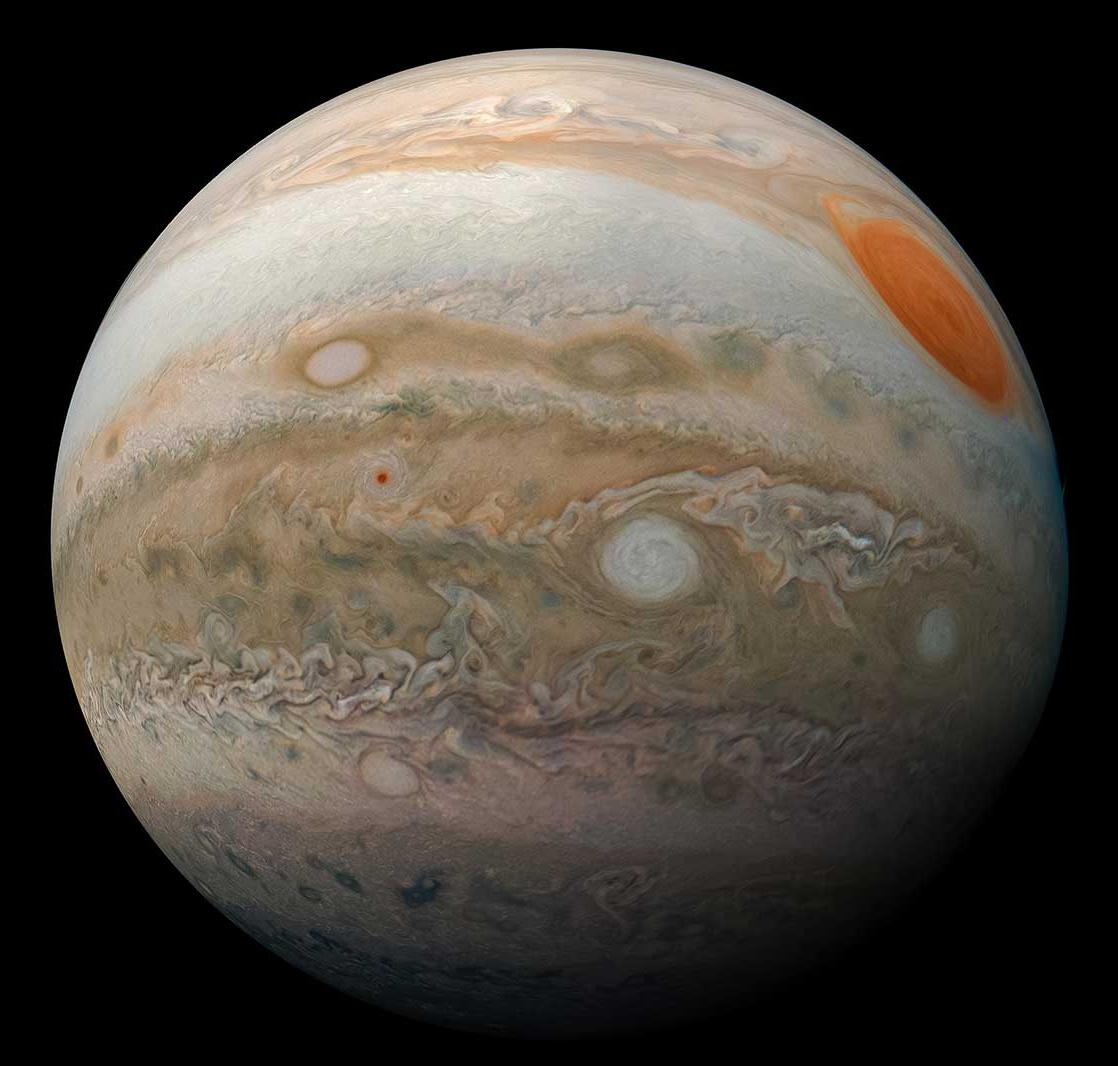
Image credit
Enhanced image by Kevin M. Gill (CC-BY) based on images provided courtesy of NASA/JPL-Caltech/SwRI/MSSSPisa and Padua
The musician’s son who was meant to be a doctor
Galileo’s father was a musician who wanted his son to become a doctor. At seventeen, Galileo enrolled at the University of Pisa to study medicine. Once there, he found he had a particular gift for mathematics. First he had to convince his father that it was a subject he could make a living from. He went on to teach it.
In 1609, while working in Padua, he heard about an instrument from the Netherlands that brought distant objects into view. He built one himself and set about improving its lenses. In a place like Venice, the instrument had an obvious use. Someone looking out from a bell tower could make out a ship on the lagoon long before it reached the harbour.
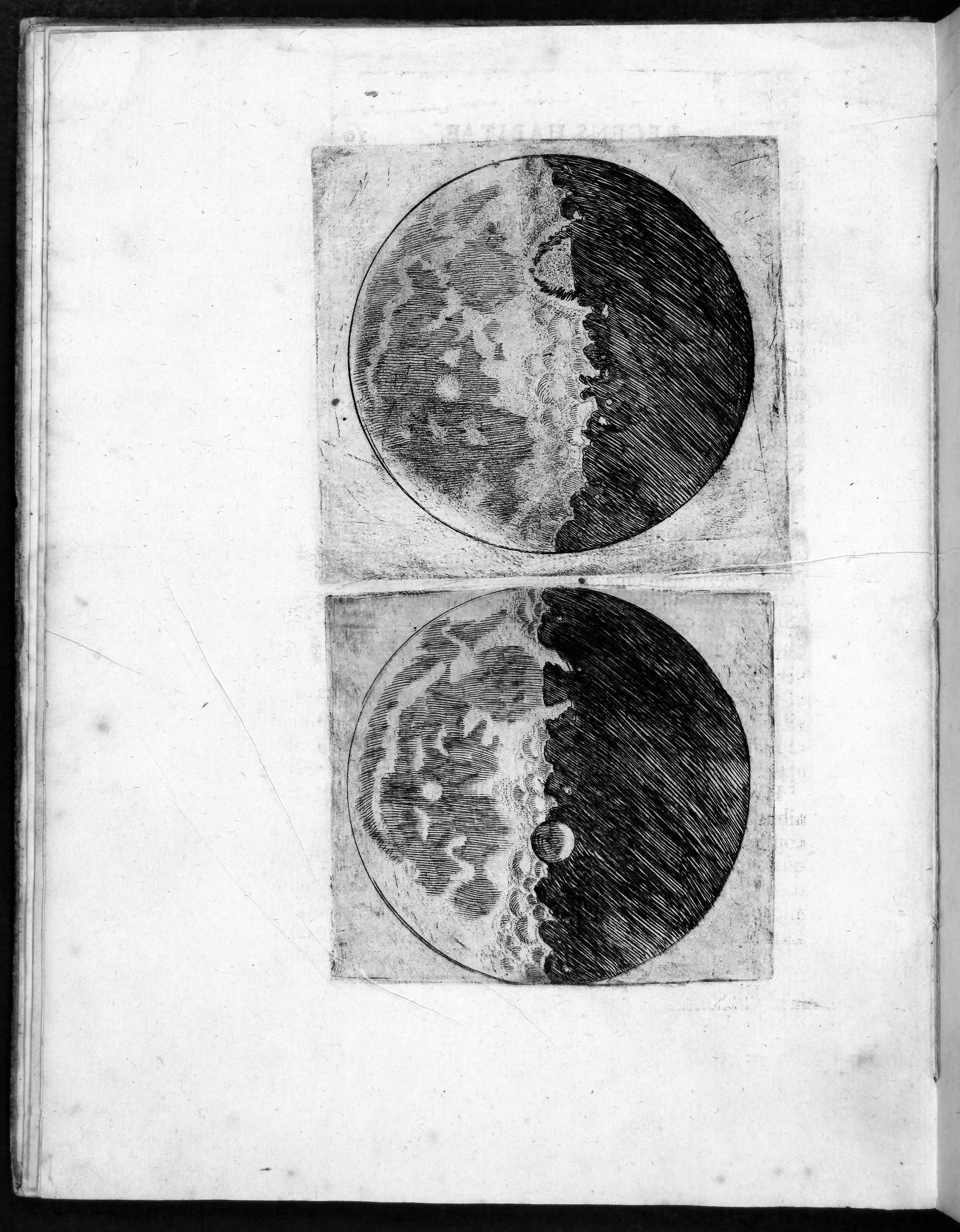
The sky was a harder test. A point of light beside a planet might be a star, a flaw in the glass or a reflection. What Galileo could do was draw what he saw and keep the drawing for the next clear night. He tried that with an object anyone could recognise with the naked eye.
Galileo before Jupiter · NASAThe Moon · 1609
A mountain sees sunrise before its valley
Look at the boundary between day and night in the two drawings. A perfectly smooth sphere would give that boundary a regular curve. Galileo drew dark notches, bright projections and little islands of light out in the shadows. How could the Sun be up on one of those islands while the ground all around it was still dark?
There is a place on Earth where that happens every day. At dawn, sunlight reaches the summit of a mountain while the valley below is still in shadow. Galileo recognised that landscape on the Moon. The shadow was also a way of measuring height. The farther out into the dark a sunlit peak stood, the taller it had to be for the Sun’s rays to reach it.
On the printed page you can still follow the hand of someone trying to make sense of what he saw. Look at the lower drawing, beside the bright-rimmed circle. That ragged edge tells you more about the shape of the ground than the brightest part of the disc.
January 1610
Which side are they on now?
Use Jupiter as your landmark. Count the points on either side, then switch nights.
Two points east of Jupiter and one to the west.
Diagram based on Galileo’s account. Sizes and distances are schematic. NASA/JPLWhat did Galileo work out by watching longer?
Night after night, the points changed position yet stayed close to Jupiter. Eventually Galileo counted four and realised they were orbiting the planet. He had found another centre of motion in the sky besides Earth.
Today we know them as Io, Europa, Ganymede and Callisto.
Account of the observations · NASA/JPLVenice · March 1610
Four moons and a very earthly dedication
A single observation would have left the simplest explanation open. Jupiter might have been passing in front of three distant stars. The odd thing was that Jupiter continued on its way and the points travelled with it. Some nights they were on one side, sometimes on the other. Repetition turned a series of tiny drawings into evidence for bodies circling Jupiter.
Galileo announced the discovery in a short book, Sidereus nuncius, or The Starry Messenger. Anyone who opened it could follow the positions night by night, then point their own telescope at Jupiter. The drawings offered something a spoken argument never could. Readers knew what to look for the next time the sky cleared.
There was one reader in particular that Galileo wanted to impress. In his notes, the Roman numerals I, II, III and IV did perfectly well for keeping track of the moons. In print he called them the Medicean stars, honouring the Medici of Florence, whose support he hoped to win. The four worlds we call Io, Europa, Ganymede and Callisto made their public debut under the name of a family on Earth.
How the moons got their names · NASAVenus
The planet that shrinks as it fills with light
Follow the lower row of the drawing from left to right. The crescent of Venus takes up a great deal of room. The almost circular disc would fit inside it with space to spare. How can a planet look smaller just as we see more of its illuminated face?
Imagine the view from Earth. When Venus passes close to us, between Earth and the Sun, most of its sunlit half faces away. We see a large crescent. As Venus travels towards the far side of the Sun, its distance from Earth grows. Now it shows more of its illuminated face and takes up less room in the sky. The shape and the size are telling the same story.
Jupiter had shown that another planet could have moons. The phases of Venus provided a different piece of evidence. Its orbit had to carry it round the far side of the Sun, a position the old Ptolemaic model ruled out. Whether Earth itself moved was a separate question. In Tycho Brahe’s system, Earth stayed still while Venus orbited the Sun. Other evidence would be needed to settle the motion of Earth.
Explore Venus in the Atlas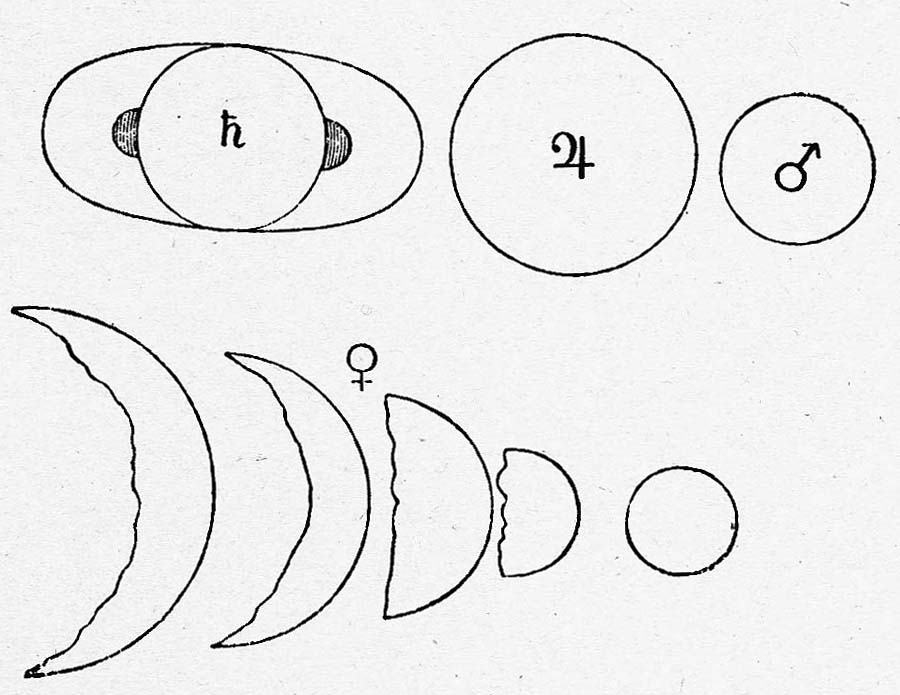
Longitude
A clock at Jupiter for finding a port on Earth
Galileo found an unexpected use for his moons. When one entered Jupiter’s shadow, its light went out. Two observers hundreds of miles apart could recognise the same moment, provided the planet was above the horizon for both of them. That gave them something exceptionally hard to come by at the time, a shared time signal over a long distance.
Suppose a table predicts an eclipse for ten at night at a reference location. In your town, it happens when local solar time is nine. Earth turns through about fifteen degrees in an hour. That difference puts you roughly fifteen degrees west of the reference. A moon slipping into shadow hundreds of millions of kilometres away has just helped put your town on a map.
On the deck of a rolling ship it was extraordinarily hard to hold such a small point in a telescope. On solid ground, mapmakers were able to put the method to work. That ambition lives on in the name of Europe’s satellite navigation system, Galileo. Look up a street on your phone today and you may be using signals from satellites named for the man who wanted to find his way by watching Jupiter.
From Jupiter’s moons to navigation · ESARome and Arcetri
The man Maria Celeste wrote to
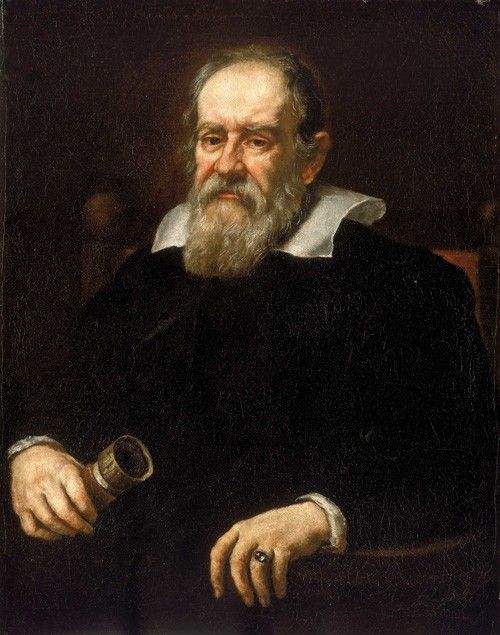
In 1632 Galileo published his Dialogue Concerning the Two Chief World Systems in Italian. Over four days, three characters discuss how to make sense of the motions of the heavens. Readers could listen in on the conversation. To the Roman Inquisition, the book defended a claim Galileo had already been ordered to give up, that Earth moves around the Sun.
In 1633 he had to appear in Rome and recant. He spent his remaining years under house arrest. He was sixty-nine at his trial. The paintings from those years show an old man. The letters that reached him show a father, too.
His eldest daughter, Virginia, had taken the name Suor Maria Celeste. Letters she wrote to him survive. ESA tells how much he valued her judgement. She died in 1634, the year after the trial. Four centuries later her name travelled into space as well. ESA chose Celeste for a mission testing new ways of navigating by satellite that complement the Galileo system.
At home, Galileo carried on working on a longstanding problem. When a ball begins rolling downhill, how does its speed change? An inclined track stretches out the descent so you have time to measure it. In 1638 his book on two new sciences, the strength of materials and the study of motion, appeared in Leiden. A copy could travel much farther than its author. Galileo died at Arcetri in 1642.
Apollo 15 · 1971
The astronaut who remembered Galileo
David Scott is standing on the Moon with a hammer in one hand and a falcon feather in the other. Before he opens his fingers, he mentions Galileo. Watch his hands, then the ground. On Earth the feather usually loses this race. On the Moon there is scarcely any atmosphere to slow it down.
Scott releases the two objects from almost the same height. As closely as the film lets us judge, they hit the ground together. The man who studied falling bodies and drew the lunar mountains was remembered that day in a place he had only ever seen through a lens.
Io · 28 June 1997
One of those dots had volcanoes
NASA named the first spacecraft to orbit Jupiter after Galileo. Its camera could resolve what had been a pinprick of light to the astronomer. Look for a small bluish cloud on Io’s sunlit left edge.
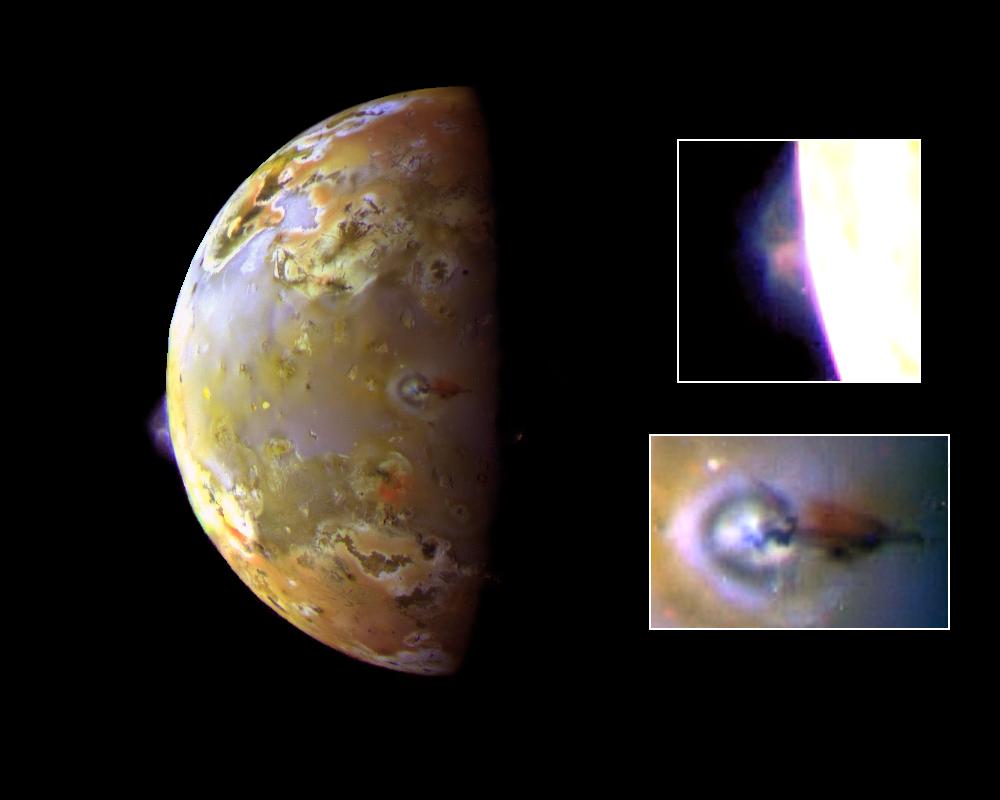
That’s Pillan Patera. Its plume rose about 140 km above the surface. The upper right inset shows a closer view of the same eruption.
Jupiter · 1995–2003
What it took to get that picture home
The photograph of Io reached Earth despite a problem that started six years before it was taken. The spacecraft’s main antenna was meant to open like an umbrella. In April 1991 some of its ribs stuck. The team could still talk to Galileo through smaller antennas, but they could carry far less information.
Engineers changed the software on board and improved reception on the ground. In December 1995 Galileo entered orbit around Jupiter. The images and measurements it sent home revealed volcanic activity on Io, a magnetic field generated by Ganymede, and evidence for an ocean beneath Europa’s ice. In 2003 the team steered the spacecraft into Jupiter’s atmosphere to avoid any chance of an accidental impact contaminating Europa.
Go back to the drawing from 7 January. Even knowing all this, the dots look much alike. Galileo never knew which had volcanoes, which hid an ocean or which generated a magnetic field. With a tube and lenses he had put together himself, he saw just enough to make it worth coming back the following night.