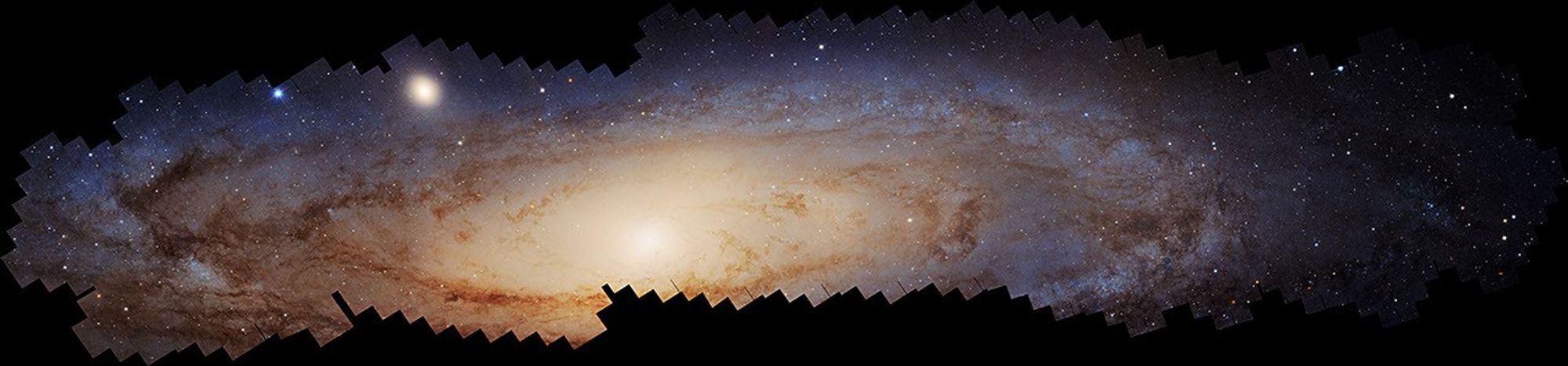
ATLAS / M31 · 2.5 MILLION LIGHT-YEARS AWAY
Andromeda,
up close.
A neighbouring galaxy, seen in more detail than ever before.THE NEAREST MAJOR GALAXY TO OURS
Two and a half million light-years.
One extraordinary portrait.
Andromeda is so vast in our sky that Hubble needed more than a decade and about 600 overlapping observations to build this panorama. It resolves roughly 200 million stars across an image made of at least 2.5 billion pixels.
Explore the full NASA image recordNASA ARCHIVE / TWO WAYS OF SEEING M31
From a distant glow
to individual stars.
A ground-based telescope captures the galaxy as a whole. Hubble then resolves details inside its bright core.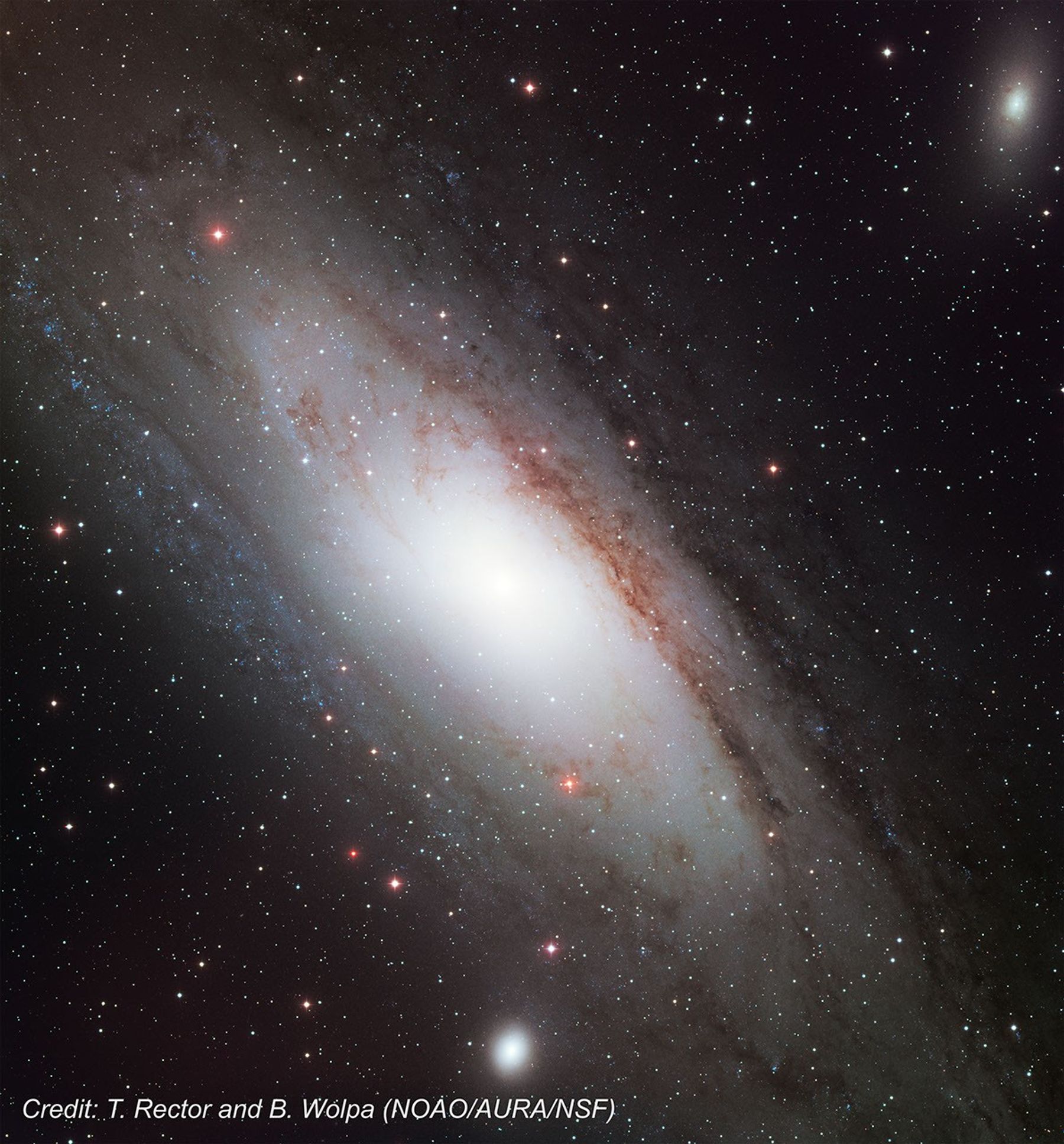
From Earth, Andromeda is a soft oval of light, large enough to find in a dark sky.
T. Rector & B. Wolpa · NOAO / AURA / NSF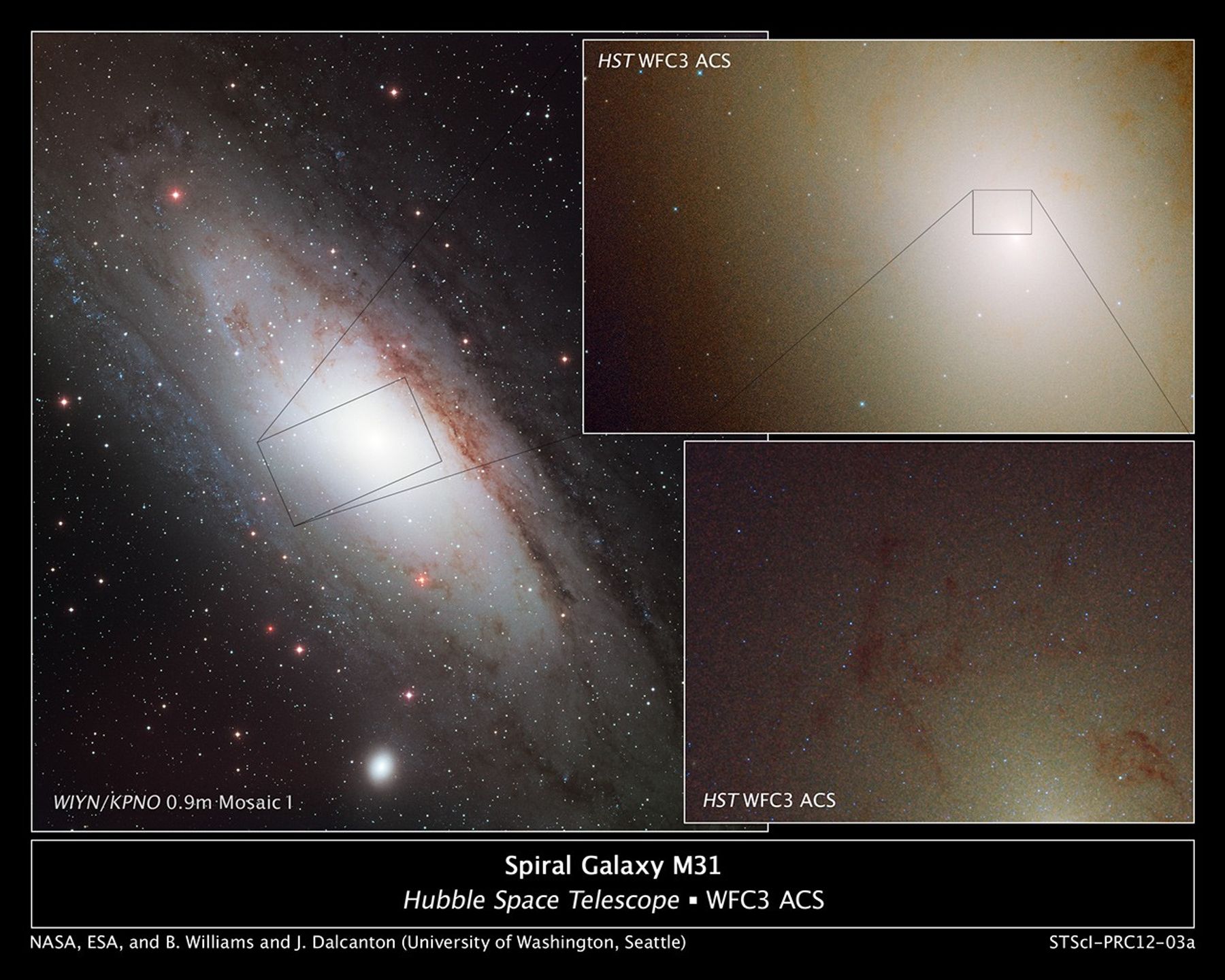
The marked patch becomes a sea of stars when Hubble observes it up close.
NASA, ESA, B. Williams, D. Lang, J. Kalirai, J. Dalcanton · T. Rector & B. Wolpa (NOAO/AURA/NSF)A THOUGHT EXPERIMENT / NOT A FLIGHT PLAN
How long would the trip take?
Let’s use the fastest speed reached by a spacecraft and imagine it could keep going in a straight line.Parker reached 430,000 mph (about 692,000 km/h) during a close pass of the Sun. Dividing 2.5 million light-years by that constant speed gives about 3.9 billion years.
The Parker figure assumes constant speed in a straight line for the entire journey. It is only a thought experiment: Parker Solar Probe follows an orbit around the Sun and cannot hold its brief peak speed on a course to Andromeda.